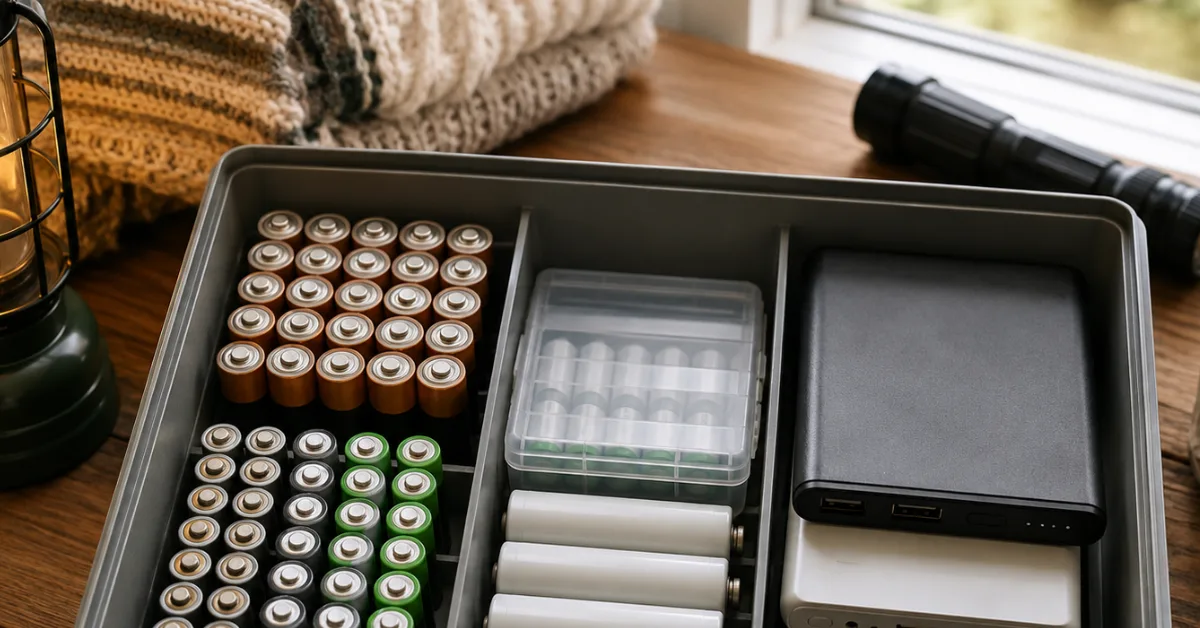
Batteries, rechargeable batteries and power banks belong in every sensible blackout preparedness kit. Yet the energy reserve often fails precisely when it is needed: batteries have leaked, rechargeable cells were stored empty, terminals have short-circuited or a power bank spent months in a hot car. Good storage therefore does not mean throwing everything into a drawer. It requires order, protection and fixed inspection dates.
Separate your supplies by battery type and intended use. Do not store disposable batteries, rechargeable AA and AAA cells, button cells, 9-volt batteries, power banks and larger device batteries in one disorganised pile. Label the boxes and record the purchase date, expiry or best-before date and the last inspection or charging date. Use older batteries first while they are still in good condition.
New disposable batteries are safest in their original packaging. Keep them dry, clean and at normal room temperature. A refrigerator or freezer is not a good storage place because condensation can damage terminals and seals. Lofts, windowsills, metal sheds and car glove compartments are also unsuitable. Heat accelerates ageing, self-discharge and leakage.
Loose batteries must not be stored with keys, coins, screws or tools. With 9-volt batteries in particular, one metal object can touch both terminals at once. This can cause intense heating and a fire. Use separate compartments, terminal caps or non-conductive sleeves. For loose used batteries and transport to a collection point, cover the terminals with non-conductive tape or package each battery separately in accordance with local rules.
Remove exhausted batteries from torches, radios and other devices immediately. Equipment that will not be used for months should, where possible, be stored without disposable batteries installed. Never mix old and new batteries, different sizes, different chemistries or very different charge levels. Always replace the complete set of batteries.
Lithium-ion batteries need different treatment. If power banks, smartphones, tool batteries or other devices will not be used for a long period, a medium state of charge is usually better than completely empty or permanently full. Around 40 to 60 per cent is a practical guide unless the manufacturer specifies otherwise. Switch stored devices off and check the charge roughly every three to six months. Deep discharge can permanently damage a battery.
A two-part system is useful for blackout preparedness. Keep a small working reserve that is regularly used, recharged and tested. The remaining long-term reserve can be stored at a battery-friendly medium charge. This provides charged equipment in an emergency without ageing every battery at 100 per cent for months. Put a fixed monthly or quarterly inspection date in your calendar.
Store rechargeable batteries and power banks in a cool, dry place away from direct sunlight. Do not place them beside radiators, cookers, gas cylinders, fuel, stacks of paper or other easily combustible material. Larger batteries for e-bikes, tools or energy systems must always be stored according to the manufacturer’s instructions. Escape routes, bedrooms and children’s rooms are unsuitable for a large battery stock.
Charge batteries only with suitable, undamaged chargers intended for them. Charge on a stable surface that is not easily combustible, not under a pillow, on a bed or sofa, or inside a closed storage box. Keep paper and textiles away from the charging area. A battery that becomes unusually hot, smells, crackles or changes shape must not be charged or used again.
Swollen, cracked, leaking, heavily corroded or otherwise damaged batteries are no longer emergency supplies. Do not put lithium-ion batteries, power banks or button cells in household waste or ordinary recycling bins. Follow local collection rules. If a battery becomes hot, smokes, hisses or releases vapour, keep your distance, move other people away from the danger area and call the fire and rescue service or local emergency number.
Button cells and small batteries must be kept in a closed place that children and pets cannot reach. A swallowed button cell is a medical emergency. Never leave new or used button cells openly on tables, in bags or in easily accessible drawers.
A simple inspection routine turns a collection of batteries into a reliable emergency reserve: check packaging, remove damaged cells, verify charge levels, test power banks, briefly switch on torches and record the dates. A small, well-rotated and safely stored supply is more valuable than a full drawer whose contents no longer work during a blackout.
Guides
General
20.07.2026
Store batteries and power banks safely: Keep emergency energy ready
Batteries, rechargeable cells and power banks only help during a blackout when they are stored cool, dry, separated and checked regularly.