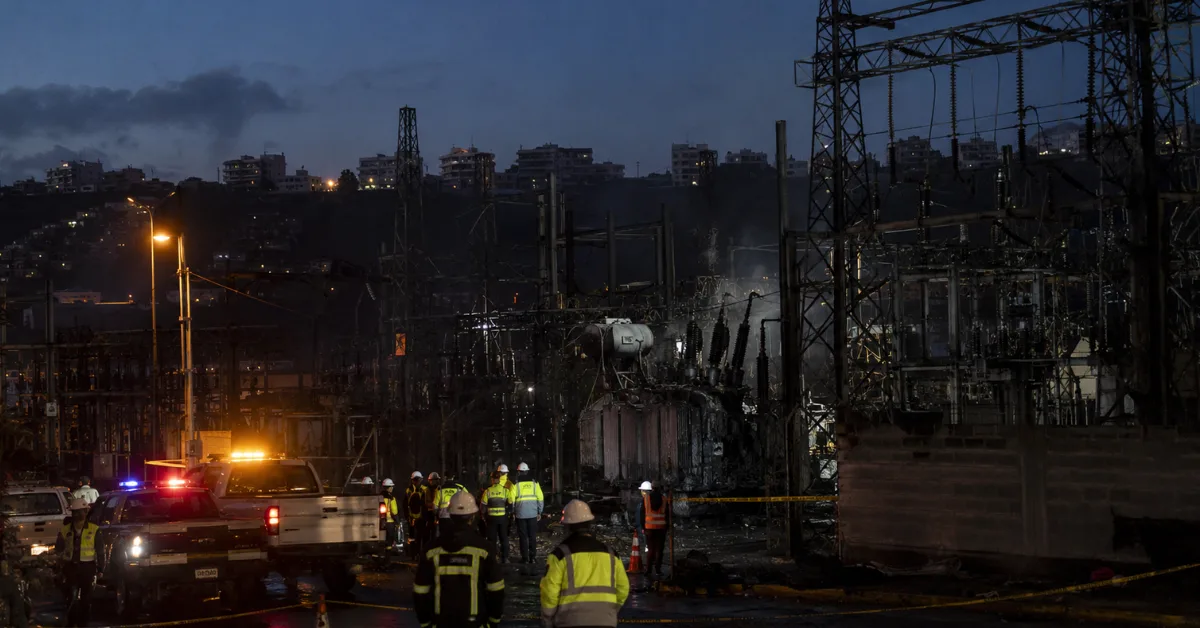
In the early hours of 30 June 2026, Ecuador received another sharp reminder of how vulnerable a power grid can be. According to state electricity company CELEC EP, an explosion occurred at around 02:07 at the Paute Molino substation. The result was not a small local fault on the edge of the system, but the shutdown of the Paute Integral complex, one of the country’s key hydropower centres.
A technical incident quickly became a problem for households, traffic, shops and public services. Power cuts were reported in several provinces. According to local reports, the national grid operator CENACE ordered targeted disconnections in coordination with distribution companies to keep the national interconnected system stable. Cities mentioned in local coverage included Quito, Guayaquil, Cuenca and Loja. In Quito, media reported interruptions in various neighbourhoods while technicians inspected the substation, checked damaged equipment and investigated the cause.
The dangerous part of such an event is its speed. At 02:07, many people are asleep. Fridges are running, phones may not be charging, lifts are waiting, pumps are working automatically. A few minutes later, nobody can be completely sure what still works at home. That is why local blackouts often feel bigger than they look on a map. When you are standing in the dark, statistics are not much comfort.
Primicias later reported that Energy Minister Juan Carlos Blum said electricity service had been restored nationwide. That is the good news. The bad news remains: one critical point can be enough to make an entire country nervous for a while. CELEC said safety protocols were activated to protect personnel, infrastructure and system stability. Generation at the Coca Codo Sinclair plant was also increased to partially compensate for the loss.
For Ecuador, the incident is especially sensitive because the country has repeatedly faced electricity shortages, maintenance work and planned cuts in recent years. This time it was not a slowly announced saving plan, but a sudden incident in a central facility. That is the difference: with planned cuts you can charge devices, prepare water and move tasks. When a substation fails at night, only what was already ready counts.
The lesson for households is simple and uncomfortable. Electricity is not guaranteed. Even if an outage lasts only minutes or a few hours, preparation decides whether you remain calm or improvise in a hurry. A charged power bank, a torch in a fixed place, drinking water, offline emergency contacts and a plan for cooling and medicines are not exaggerated. They are exactly what turns a night-time disruption into a manageable incident.
Source: Reuters, Primicias and Teleamazonas, 30 June 2026, citing CELEC EP, CENACE and Ecuador’s energy ministry.
Latest updates
General
30.06.2026
Explosion in Ecuador: Paute Molino substation knocks several provinces off balance
An explosion at Ecuador’s Paute Molino substation caused power cuts in several provinces on 30 June 2026. The incident shows how one critical grid point can disrupt daily life.