An electric car is not automatically useless during a power cut. On the contrary, a well-charged traction battery can preserve personal mobility and, in suitably equipped models, even supply small electrical loads. The key is not to wait until charging stations, traffic lights and mobile networks have already failed. An EV therefore needs its own blackout plan.
Watch weather warnings and notices from the electricity network operator. If a severe storm, flooding or a strained supply situation is approaching, charge the vehicle early in accordance with the manufacturer's recommendations. The battery does not need to remain at one hundred per cent every day, but a higher state of charge can be sensible before a possible emergency. Do not wait until the final hour: after a warning, many drivers may head to public rapid chargers at the same time, while individual stations may already be switched off, overloaded or inaccessible.
Set a fixed range reserve. It should cover necessary journeys to a doctor, pharmacy, relatives, emergency shelter or a reliable charging point. Do not rely solely on an optimistic dashboard estimate. Heat, cold, rain, congestion, diversions, climate control and high speed can all increase consumption. Record two or three alternative charging locations in different directions and check whether they are accessible around the clock. Offline maps, written addresses and operator telephone numbers are useful when apps or mobile internet stop working.
Once the electricity fails, limit driving to what is essential. Public chargers require grid power and often also data connections or functioning payment systems. A station that appears operational from the outside may therefore be unable to charge. Do not drive from charger to charger without obtaining information first. Every unnecessary search consumes the reserve that may later be needed for an important journey.
Use the vehicle's energy-saving mode, reduce speed and avoid unnecessary pre-heating or pre-cooling. Charge phones and lamps, where possible, only during necessary journeys or through outlets intended for this purpose. Do not leave the car switched on for hours merely to power small devices. This can unnecessarily strain the twelve-volt battery and vehicle systems.
Some models offer vehicle-to-load, vehicle-to-home or bidirectional charging. These systems can provide energy from the car to individual appliances or a building installation. They are not available on every electric vehicle and must never be improvised. Use only approved adapters, charging equipment and installations. Supplying fixed household wiring requires compatible technology, safe isolation from the public grid and normally professional installation. Never connect homemade cables to a wall socket or the charging port.
After heavy rain, the same rule applies as for every other vehicle: never drive through flooded roads. Water may be deeper than it appears, a current may move the car, and hidden obstacles or open manholes may lie below the surface. If an EV has been flooded or its high-voltage battery has stood in water, do not start, charge or move it yourself. Keep away, do not park it in a garage or near buildings, and contact the fire service, manufacturer, workshop or recovery service. Salt water in particular can cause delayed short circuits and fires.
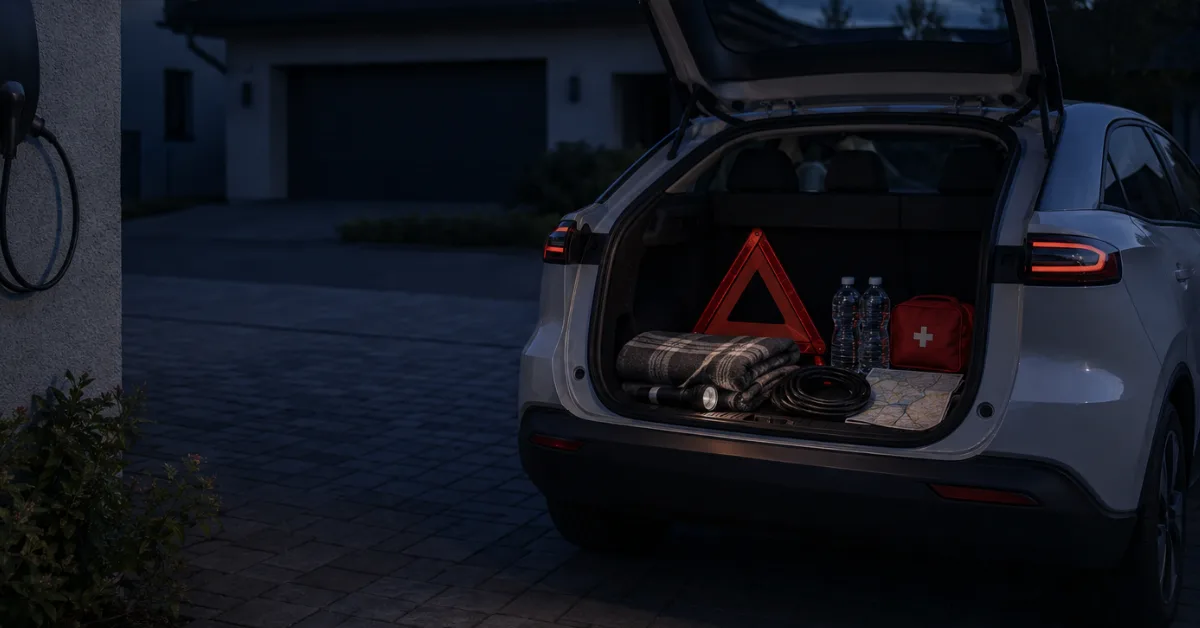
Keep the charging cable, high-visibility vest, torch, work gloves, drinking water, a paper map and important telephone numbers in the vehicle. Regularly check tyre pressure, the charging cable and the condition of the twelve-volt battery. An electric car remains an advantage in a blackout when its battery is not empty, the route is planned and its technology is used safely.
Sources: U.S. Department of Energy, information on bidirectional charging and mobile energy storage; National Highway Traffic Safety Administration, safety of flooded electric and hybrid vehicles; Ready.gov, guidance on power cuts and evacuation planning.
Guides
General
26.07.2026
Electric car in a blackout: Keep the battery as your mobility reserve
A well-charged electric car can preserve essential mobility during a power cut. Early charging, a fixed range reserve, alternative chargers and safe handling of floods and backup-power functions are crucial.