The heat is pressing down, sockets are silent, and a normal summer day suddenly turns into a stress test for everyday life. In northern France, thousands of households were left without electricity on Wednesday while a severe heatwave held large parts of western Europe in its grip. According to local authorities, the outage was triggered by a transformer incident linked to the extreme temperatures. Nobody was injured, but the situation made one thing painfully clear: heat and power supply can become a serious problem at the same time.
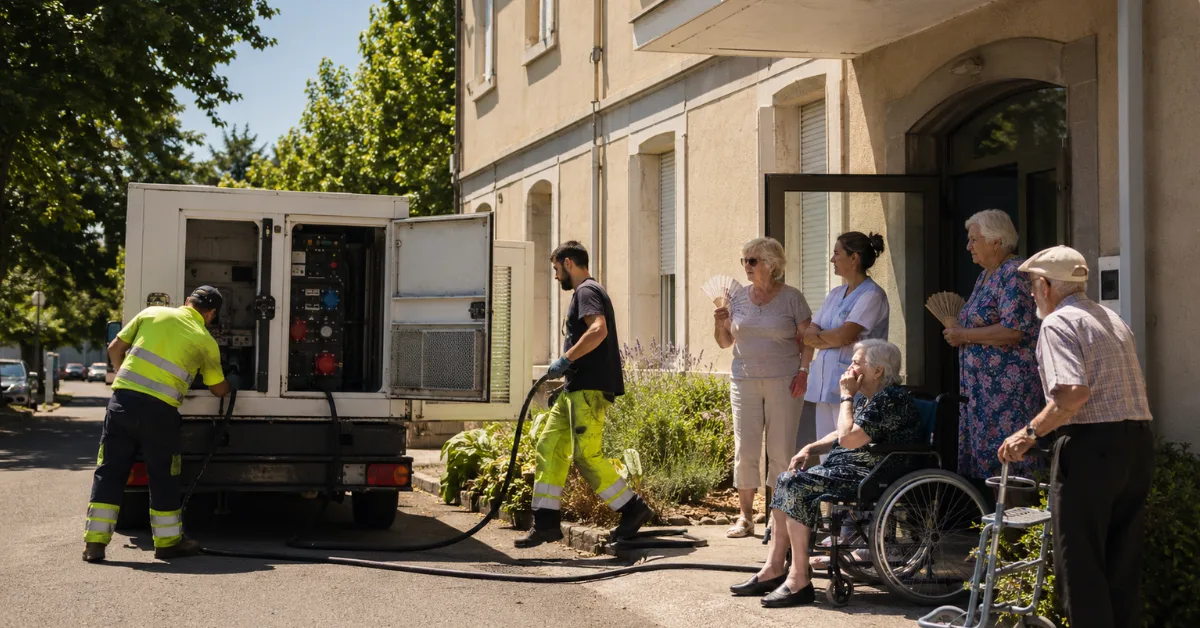
The most sensitive sites came first. Emergency teams prioritised healthcare centres, critical facilities and retirement homes. Generators were brought in so that vulnerable people would not have to face heat, darkness and failing cooling systems all at once. For many private households, however, the immediate reality was waiting, sweating and improvising. Anyone without a charged phone, a torch, a battery radio and drinking water close at hand quickly learned how thin the comfort margin of modern life can be.
This is part of a wider European picture. In several countries, temperatures are far above normal. Heat is putting pressure on people, transport, schools, agriculture and the energy system at the same time. When fans, air conditioners, freezers and pumps run at full speed, electricity demand rises sharply. At the same time, technical equipment can suffer under extreme heat. In that moment, one fault can be enough to turn a local technical incident into a visible power cut for thousands.
Great Britain was also watching its grid closely on the same day. The grid operator asked generators to make extra power available because high temperatures, weak wind generation and rising demand were shrinking the safety margin. An immediate blackout was not expected, but the warning itself says enough: summer heat is no longer just a health issue. It is also an infrastructure issue.
For Blackout-Tip, the lesson is clear. Preparedness must not focus only on winter, storms and heavy rain. A hot afternoon without electricity can be just as unpleasant and dangerous. Anyone who has drinking water, charged power banks, a battery radio, simple LED lighting and a cooler room prepared is in a much better position.
The French incident is not the end of the world. But it is a loud wake-up call. Modern cities depend on electricity like an invisible lifeline. When heat strains that lifeline, many households discover how little reserve they really have.
In flats and homes without proper shade, this kind of outage can quickly become more than a small inconvenience. Fridges lose temperature, lifts stop, internet routers fail, local card payments may stop working and people start searching for reliable information. Anyone who begins looking for batteries, water or a working lamp only after the power has gone is already losing valuable time. That is why the French case is not just a technical incident. It is an everyday-life warning: many households are comfortable, but not truly resilient.
Source: Reuters, 24.06.2026.
Latest updates
General
24.06.2026
Heatwave leaves homes powerless: France battles power cuts
Thousands of homes in northern France lost electricity during a severe heatwave. The incident shows why blackout preparedness is not only a winter topic.