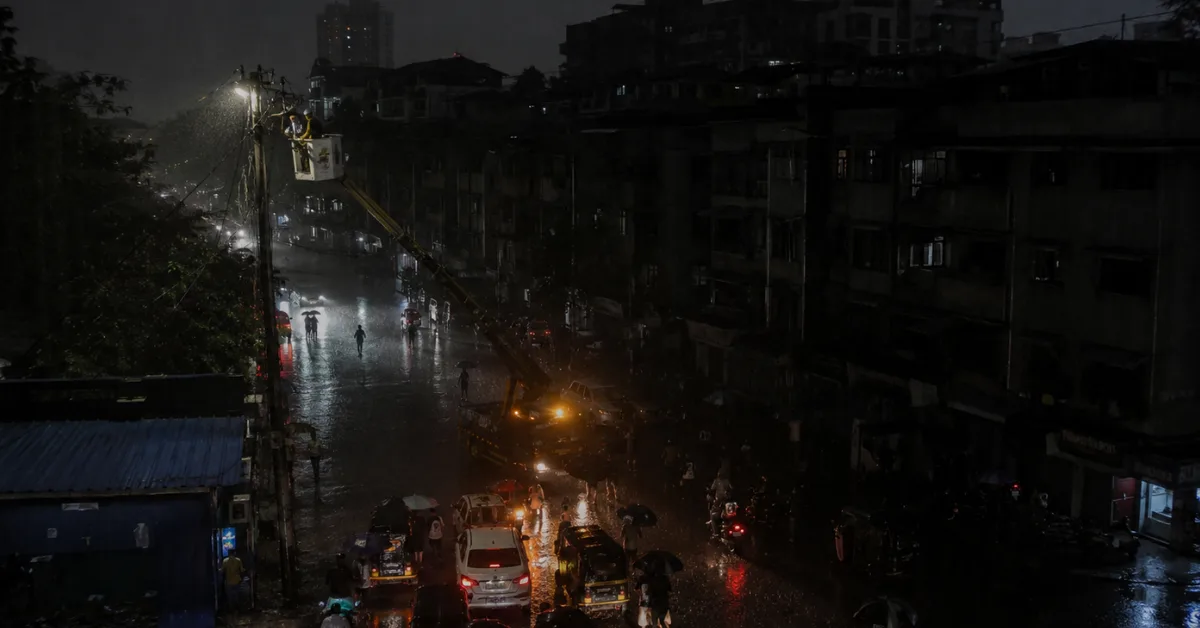
A single fault on a high-voltage line – and suddenly the lights went out in several cities east of Mumbai. On the evening of Friday, 17 July 2026, more than 460,000 electricity connections in the Kalyan region were affected by a widespread outage. For hundreds of thousands of households and businesses, it meant an unexpected evening without lights, fans, lifts, cooling and reliable communication.
According to the Maharashtra State Electricity Distribution Company Limited, or MSEDCL, the 220 kV Padgha–PAL transmission line tripped at around 7.40 pm local time. The technical fault interrupted supplies in Kalyan, Dombivli, Ulhasnagar and Badlapur. This was not a nationwide blackout, but the scale was enormous for a regional power cut. The reported figure refers to electricity customers or connections, not individual people, so the number of residents who experienced the consequences may have been considerably higher.
The Kalyan East supply division was hit particularly hard. Around 325,000 connections lost power there. The affected locations included Sonarpada, Casa Rio, Casa Bella, parts of Netivali, Epic, Downtown, Lakeshore, Usatane and Lodha Premier. Several 22 kV feeders went out of service at the same time, leaving entire residential and commercial districts in darkness.
Ulhasnagar was also badly affected. Around 112,000 connections were without electricity after the fault disrupted the Gaikwadpada, Ashelpada and Anandnagar switching stations, as well as all 22 kV feeders supplied from the Anandnagar extra-high-voltage substation. A further roughly 27,000 connections were affected in Badlapur. There, the outage involved the Poddar switching station and the 22 kV Mankivali feeder supplied through Kharvai.
The utility said technical crews were deployed immediately and treated restoration as a high-priority operation. C. R. Mishra, chief engineer of the Kalyan division, said the teams had been mobilised without delay. However, persistent rain made the repair work more difficult and slowed access to parts of the equipment. Electricity was finally restored at around 10 pm, a little more than two hours after the outage began.
Two hours may not sound dramatic on paper. In densely populated urban areas, however, that is enough time to stop lifts, disrupt shops, put refrigerated goods under pressure and make traffic at unlit junctions more dangerous. On hot and humid nights, fans and air-conditioning systems also fall silent. Anyone dependent on electric water pumps, medical equipment or charged phones quickly discovers how much everyday life can rely on a single functioning line.
The incident shows how a technical failure on one major transmission line can spread through multiple substations and switching facilities until hundreds of thousands of homes are affected. The good news is that power returned relatively quickly. The uncomfortable news is that preparation still matters even when an outage lasts only a few hours. Short, sudden interruptions are often underestimated because many people react only when the fridge is already warming up, the phone battery is nearly empty or the lift has stopped.
Charged power banks, torches, drinking water, a battery-powered radio and a plan for lifts, medicines and cooling equipment can make a real difference in such moments. Kalyan had light again after just over two hours. Yet for more than 460,000 affected connections, that Friday evening delivered a clear warning: the grid only has to stumble once for an entire region to grind to a halt.
Source: The Times of India, 17 July 2026; Maharashtra State Electricity Distribution Company Limited (MSEDCL).
Latest updates
General
18.07.2026
India in darkness: Line fault cuts power to 460,000 connections
A fault on a 220 kV transmission line cut electricity to more than 460,000 connections in the Kalyan region east of Mumbai on 17 July 2026. Persistent rain complicated repairs before power returned just over two hours later.