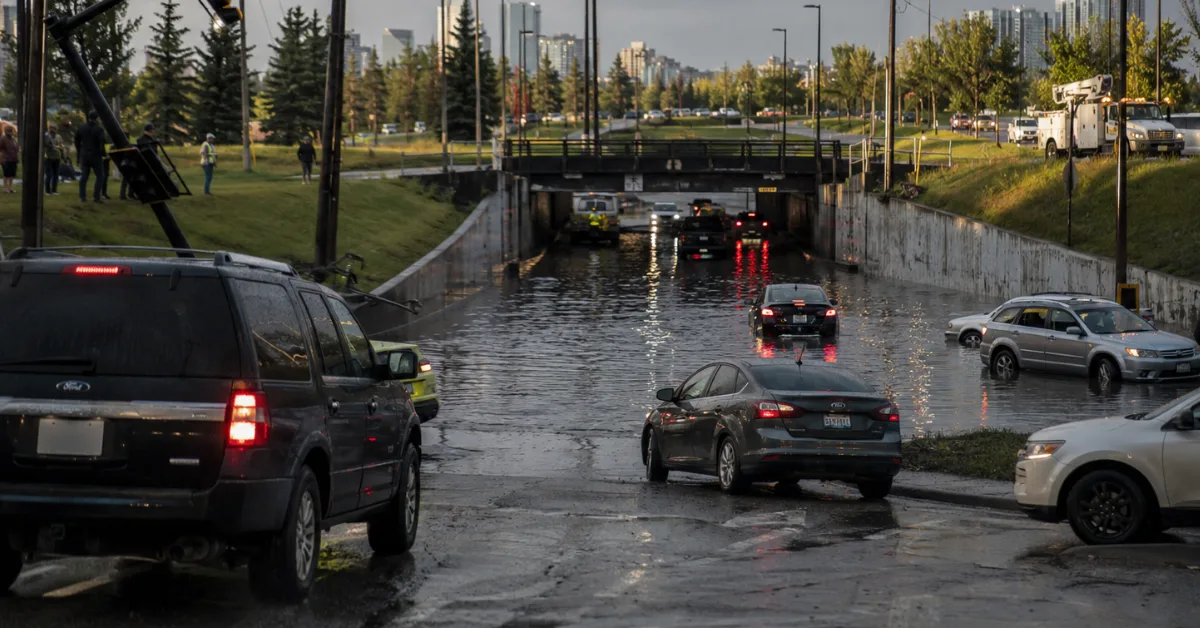
Edmonton experienced a night that turned a summer evening into an emergency within minutes. On Saturday, 25 July 2026, a violent thunderstorm swept across the capital of the Canadian province of Alberta. Strong winds, torrential rain and intense lightning struck the city almost at the same time. Shortly before midnight, local outage reports indicated that about 9,500 homes were without electricity. While thousands sat in darkness, important roads were turning into sheets of water.
The situation was particularly dramatic on Whitemud Drive in west Edmonton. Underpasses filled with water, water burst from overloaded manholes and a section of the expressway had to be closed. Emergency services received numerous 911 calls. Vehicles stopped before flooded areas and drivers were forced to find detours. The downpour showed once again how quickly one storm can hit transport, drainage systems and the electricity supply at the same time.
The storm was also felt immediately at Commonwealth Stadium, where a Post Malone concert was taking place on Saturday evening. Video footage showed spectators leaving their seats as wind and rain lashed the open stands. The weather had already been classified as dangerous. Environment Canada warned of severe thunderstorms, hail, lightning and even a possible tornado risk. For many concertgoers, the planned evening of music suddenly became a hurried escape from the weather.
At the same time, electricity provider EPCOR reported numerous outages across the city. At about 11.50 pm, a widely shared assessment of the outage situation showed 9,517 homes affected. The failures were concentrated in several neighbourhoods and occurred during the strongest phase of the storm. It was later reported that power had been restored to the affected residents. On the official outage map, only isolated outages were still visible the following day.
The incident is especially striking because Edmonton had already been hit several times in July by severe thunderstorms, flooding and power cuts. In many places, the ground and drainage systems were already under pressure. When large amounts of rain then fall within a short time, underpasses and low-lying roads can become impassable within minutes. At the same time, wind, lightning and falling branches can endanger local power lines and technical equipment.
For households, an outage at night means more than missing lights. Shops, traffic signals, lifts and cashless payment systems can also fail within seconds or operate only to a limited extent. Refrigerators stop, internet routers go offline, electric garage doors may no longer work and mobile phones become the most important source of information. Anyone without charged power banks, torches or battery-powered radios close at hand can quickly lose track of what is happening. The situation becomes even more difficult when a blackout coincides with flooded roads and it is impossible to drive safely out of the affected area.
Edmonton was fortunate that the electricity supply appears to have been restored relatively quickly. Yet the night shows how suddenly a modern city can become vulnerable at several points at once. One thunderstorm was enough to close roads, interrupt an event and disconnect thousands of homes from the grid. The key task for the authorities and EPCOR will now be to assess the damage and protect particularly vulnerable areas before the next severe storm.
Source: Global News, “Severe thunderstorm flooding shuts down Whitemud Drive in west Edmonton”, 26 July 2026; Reuters Connect, “Severe Thunderstorm Brings Strong Winds, Heavy Rain to Edmonton”, 26 July 2026; EPCOR, current Edmonton power outage map; Alberta Storm Reports, outage report dated 25 July 2026.
Latest updates
General
26.07.2026
Storm throws Edmonton into chaos: About 9,500 homes lose power
Torrential rain, flooded underpasses and thousands of outages: A severe thunderstorm disrupted Edmonton within minutes.