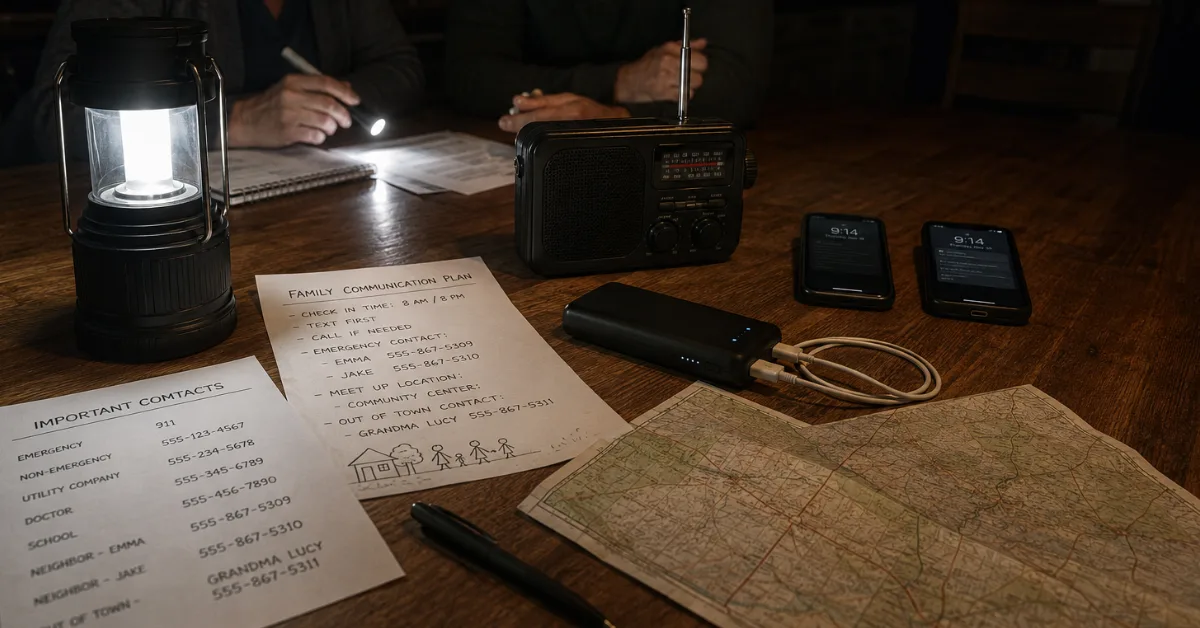
When mobile phone masts, routers and charging points gradually fail during a power cut, staying reachable quickly becomes a problem. A smartphone remains important, but it must not be the only communication plan. Anyone who waits until the blackout to decide whom to contact, when and by which method loses time, battery power and often patience. A simple plan ensures that family, friends and neighbours know what to do even when calls no longer work reliably.
Start by making a short contact list on paper. Include the telephone numbers of relatives, neighbours, a doctor, pharmacy, school, employer and relevant local services. Add one contact person outside your region. When local networks are overloaded, someone in another city or country may be able to collect messages and pass them to several family members. Keep one copy with the emergency supplies, one in the car and one in a wallet.
Agree on two meeting places: one close to home and another outside the neighbourhood. Also set fixed check-in times, for example in the morning and evening. This prevents everyone from calling or sending messages continuously. A status message should be short and clear: name, location, condition and the next planned contact. A sentence such as “Everyone safe, at Maria’s, next update at 6 p.m.” is more useful than many separate messages.
If the mobile network is still operating, send text messages rather than making long calls whenever possible. SMS and short messenger messages use less network capacity and may be delivered later when a connection briefly returns. Keep necessary calls short and use emergency numbers only for genuine emergencies. Avoid videos, large photographs, livestreams and constantly refreshing social media. This saves battery power and reduces pressure on an overloaded network.
Conserve energy consistently. Enable low-power mode, reduce screen brightness and turn off Bluetooth, Wi-Fi, location services and mobile data when they are not needed. With a very weak signal, the phone constantly searches for a network and uses especially large amounts of power. Put it into flight mode for periods and check the connection only at the agreed times. Keep at least one charged power bank, suitable cables and, where possible, a car charger ready.
Plan several ways to receive information. A battery-powered or hand-crank radio provides updates when the internet and mobile service fail. A traditional corded telephone may continue to work on some landlines, while cordless phones and routers require electricity. For short distances, legally permitted two-way radios can help between the home, neighbours or a meeting point. Agree on the channel, times and short call signs in advance, and follow local radio regulations.
Save important maps, addresses, medical details and documents offline, but do not rely exclusively on digital files. Write critical information on paper as well. In an apartment building or neighbourhood, a fixed information point can be useful, such as a noticeboard or an agreed front door. Short, dated notes can be left there without having to search for every household separately.
Assess reports critically. Whenever possible, use information from authorities, electricity network operators, broadcasters and emergency organisations. Do not forward unconfirmed rumours, because false reports can block routes or place people at unnecessary risk during a tense situation. Record the time of important information, as old messages can quickly reappear during a prolonged outage.
Test the communication plan at least twice a year. Check telephone numbers, batteries, power banks, the radio and two-way radios. Staying reachable in a blackout does not depend on one device, but on clear agreements, short messages, several channels and some paper. These simple preparations prevent a power cut from becoming an information crisis as well.
Sources: Federal Communications Commission, Emergency Communications Tips; Ready.gov, Family Emergency Communication Plan and power outage guidance.
Guides
General
27.07.2026
Reachable during a blackout: Build a communication plan that works
When mobile service, internet and routers begin to fail, clear agreements matter more than frantic calls. A contact list, check-in times, meeting points, battery reserves and several communication channels keep you organised.