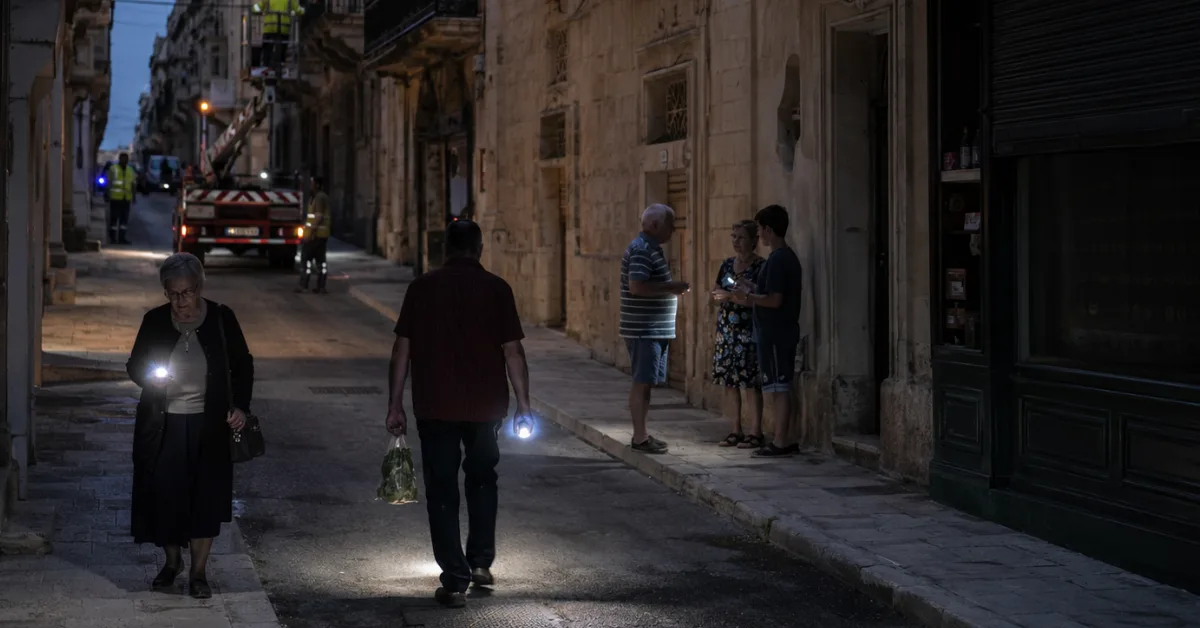
Malta has seen how quickly a modern electricity grid can reach its limits after an exceptional heatwave. On Thursday, 23 July 2026, state energy company Enemalta said technicians had repaired two damaged underground cables supplying the capital, Valletta. Power returned to the city, while teams continued working on local outages in other parts of the island nation.
Behind the series of failures was a dangerous combination of extreme heat, record consumption and vulnerable infrastructure. Electricity demand reached a historic 741 megawatts on Tuesday. The previous day, it had already climbed to 713 megawatts. By comparison, the record during the severe 2023 heatwave was 663 megawatts. Temperatures above 40 degrees kept air conditioners, fans and refrigeration equipment running almost continuously. Malta also recorded 43.3 degrees Celsius, a new July record.
For many people, a technical fault quickly became a nightmare. Households spent hours in overheated flats without fans or air conditioning. Lifts stopped, some medical equipment could only operate where backup power was available, and food spoiled in fridges and freezers. Residents said they slept in communal corridors or sheltered from the heat in air-conditioned cars.
Public life also began to buckle. Power failed at the prime minister’s office and several ministries. In Valletta’s law courts, even a high-profile trial had to be temporarily interrupted. Restaurants threw away spoiled food, shops lost income and electronic payment systems stopped working in some places. For a densely populated island in the middle of the peak tourist season, this was particularly serious: hotels, restaurants and small businesses rely on refrigeration, cooling and card payments.
Even football was not spared. During the second half of the UEFA Conference League match between Floriana and Drita at the Centenary Stadium in Ta’ Qali, the lights went out. The supply failed several times while attempts were made to keep a generator running steadily. According to the Malta Football Association, the heat also made it harder to operate the backup generator. The match was completed, but the image of a dark stadium matched the country’s situation alarmingly well.
Enemalta said the sustained high temperatures had contributed to faults in high-voltage underground cables. At the same time, unprecedented demand placed enormous strain on the distribution network. Upgraded sections performed better, while most faults occurred in areas still waiting for reinforcement. In Valletta, engineers not only had to repair two cables. A temporary generator also developed problems and had to be replaced.
The government announced compensation for households and businesses that were without electricity for at least six hours. Detailed information on how to apply was not initially available. Under the previous scheme, households received credits of between 60 and 110 euros depending on the duration. Businesses could receive compensation worth up to 200 per cent of their average monthly electricity consumption. It was not immediately clear whether the same amounts would apply this time.
Malta did not experience a complete nationwide blackout. However, the series of local outages showed how quickly heat and record demand can strike several important areas at once. Anyone who has emergency lighting, charged power banks, drinking water, a plan for medicines and a strategy for refrigerated food gains valuable time. During extreme heat, a power cut can become a health and supply problem within only a few hours.
Sources: Reuters, 22 July 2026; Newsbook Malta, 23 July 2026; Times of Malta, 22 and 23 July 2026.
Latest updates
General
24.07.2026
Malta sweats in the dark as record heat pushes the power grid to its limit
Outages hit Valletta, government offices, courts, businesses and even a UEFA match. Power returned to the capital only after cable repairs.