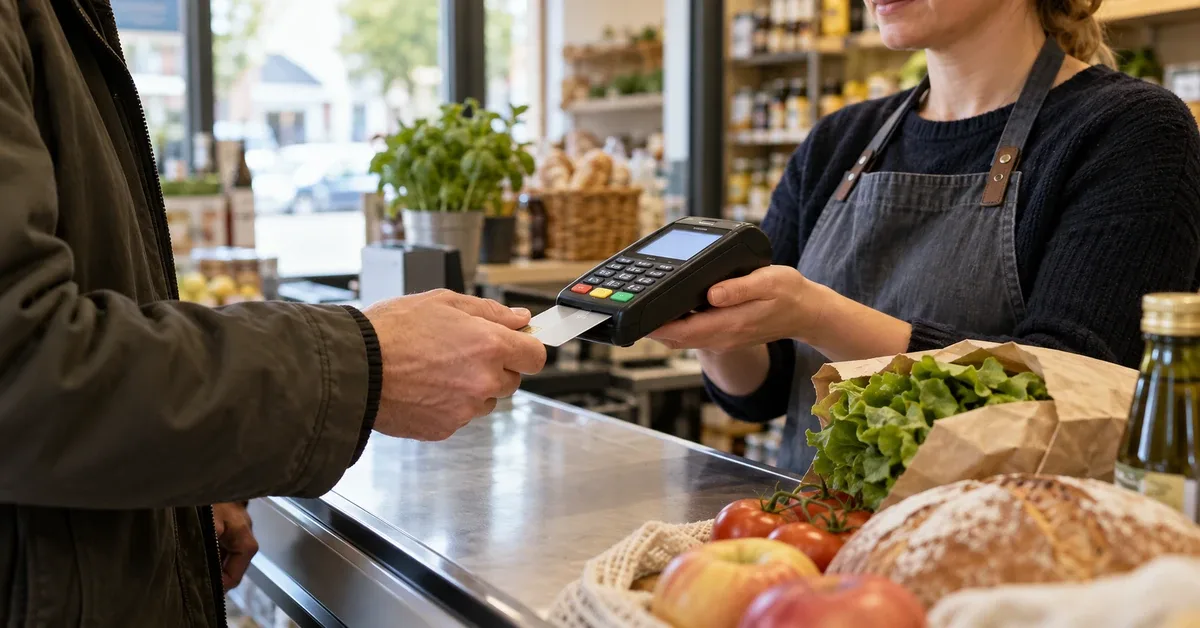
Mastercard has announced new requirements for offline payments across Europe. Newly issued cards will support the feature from February 2027; new and replacement terminals must support it by May 2027. The announcement reported on October 8 describes a future rollout. It does not mean that every Mastercard card and every shop can already keep processing payments during a disruption today.
According to the company, a transaction using the card's chip and PIN can be approved locally when a terminal loses its connection. Spending limits are stored on the chip beforehand. The issuing bank sets the limit, with up to 200 euros per transaction described in the announcement. The payment is submitted for clearing after connectivity returns. This ceiling is not a promise that every individual card has a full 200 euros available for offline spending.
The distinction between connectivity and electrical power is essential. A terminal that is switched off cannot process a payment through this feature. Mastercard cites shops in Latvia that continued operating during a storm using local generators. That example illustrates the additional requirement: local authorisation does not supply electricity. A shop must also be open and able to provide goods and operate its checkout.
Consumers should therefore keep expectations realistic. A working card, a compatible powered terminal, and the issuing bank's conditions must fit together. The described method uses chip and PIN. The statement does not provide a universal guarantee for contactless payments, every smartphone wallet, or cards from all other providers. Anyone depending entirely on a single digital payment method should consider these distinctions when thinking about personal preparedness.
The deadlines cover different parts of the payment system. Newly issued cards come first, followed by new or replacement terminals. Existing equipment does not automatically acquire a different technical capability because an announcement has been published. Our editorial assessment is that a transition with uneven equipment coverage should be expected. Whether a particular store supports the feature on a particular date must be checked directly.
Useful questions for your bank include whether your specific card supports offline transactions, what limit applies, and which conditions you need to understand. These questions concern confirmed features of a product you already hold. This report is not a recommendation to order a new card immediately or choose a particular provider. Without individual confirmation from the bank, the announced maximum should not be treated as a reliably available personal emergency budget.
A complementary payment option remains useful for household preparedness. Germany's Federal Office of Civil Protection and Disaster Assistance recommends keeping cash because ATMs may stop working during a power outage. An appropriate small reserve can be considered ahead of time without prescribing one universal amount. Waiting until the interruption to rely on the nearest ATM may not solve the problem.
For small businesses, a practical planning question is which parts of the checkout can continue working: terminal, electricity supply, connection, and approved operating procedure. This editorial suggestion does not replace technical advice from the payment service provider. Staff need confirmed procedures and understandable customer information. An announced offline feature should neither be advertised as an unlimited payment guarantee nor forced through improvised changes to checkout equipment or its electrical connections.
Sources: Mastercard's European offline-payment announcement; reporting dated 8 October 2026; BBK power-outage preparedness guidance. Editorial update: 9 October 2026.
Latest updates
General
09.10.2026
Mastercard plans offline payments in Europe from 2027
New cards and terminals will support payments without a network connection. Terminals still need power, and implementation will be phased.