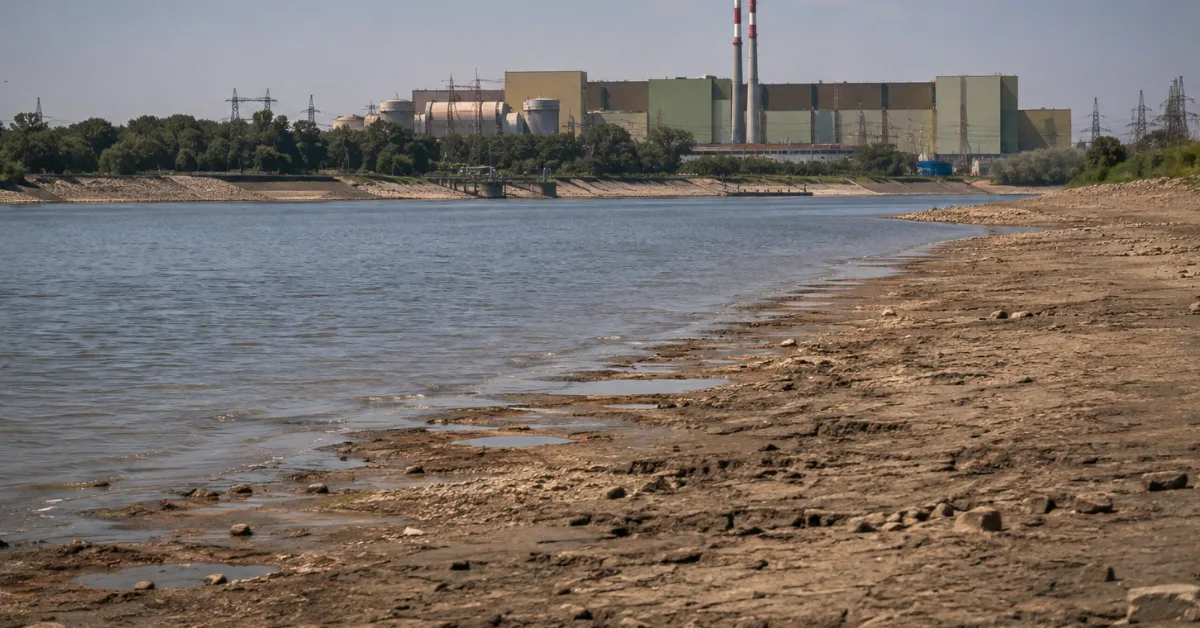
Hungary has pulled the emergency brake: the Paks nuclear power plant, normally the backbone of the country’s electricity supply, has been shut down completely because of the dramatically low level of the Danube. It is the first time in more than four decades that the country’s only nuclear facility has gone fully offline because there is not enough cooling water. In the middle of a heatwave, Hungary has therefore lost a plant that normally provides almost half of its electricity.
The situation had been worsening for days. Paks lies about 100 kilometres south of Budapest and uses water from the Danube to cool its four reactor units. After months of drought and repeated heatwaves, the river has fallen to historic lows. Before the plant was stopped, output had already been reduced step by step to only around ten per cent. Production is now completely at a standstill, and nobody can say with certainty how quickly enough water will return.
Prime Minister Péter Magyar warned of several critical days for the power grid. Temperatures of up to 40 degrees Celsius are simultaneously pushing up demand for air conditioning and refrigeration. At precisely this moment, around 2,000 megawatts of generating capacity are missing. The government is therefore considering mandatory consumption limits for large companies and is asking households, public authorities and businesses to use less electricity, especially in the evening.
Oil and energy company MOL has announced that it will cut its consumption significantly. State buildings are also expected to save power: decorative lighting is being switched off, while non-essential events and meetings may be postponed. Even so, Hungary must buy additional electricity from abroad. That will be expensive. Reuters estimates the possible economic burden at 100 to 200 billion forints, equivalent to several hundred million dollars.
What makes the situation particularly difficult is that an outage of this kind cannot simply be reversed like flicking a light switch. A nuclear plant must be shut down in a controlled manner, monitored and later restarted step by step. Even if the Danube level suddenly rises, full output will not immediately be available. At the same time, extreme heat can place additional stress on power lines, transformers and generating stations. One bottleneck can therefore trigger a chain of further problems.
The crisis does not stop at Hungary’s borders. In Serbia, the largest hydropower plant on the Danube is producing only a fraction of its normal output. Romania is also struggling with electricity generation. Low river levels are disrupting shipping, tourism and water supplies as well. More than one hundred Hungarian municipalities have already introduced restrictions on water use.
No nationwide blackout has been reported so far, and the authorities say supply remains secure. But the available reserve has clearly become smaller. If another major power plant, an important transmission line or a cross-border import were now to fail, the situation could become much more serious very quickly. That is the real warning from this event: power grids depend not only on cables, fuel and technology, but also on water, weather and neighbouring countries that continue to function.
For households, this is not a reason to panic, but it is a clear wake-up call. Charged power banks, battery lamps, drinking water, shelf-stable food, cash, a radio and a plan for medicines or cooling are not an overreaction. Anyone who relies on electric shutters, garage doors or cooking appliances should also know the manual alternative. Hungary is showing how quickly extreme heat and a dried-out river can put even a modern European energy system under pressure.
Source: Reuters, 1 and 2 August 2026; Associated Press, 1 August 2026; Euronews, 30 July 2026.
Latest updates
General
02.08.2026
Danube at record low: Hungary shuts down its only nuclear plant
Historic low water levels have forced Hungary to shut down the Paks nuclear power plant. Nearly half of domestic electricity generation disappears in the middle of a heatwave.