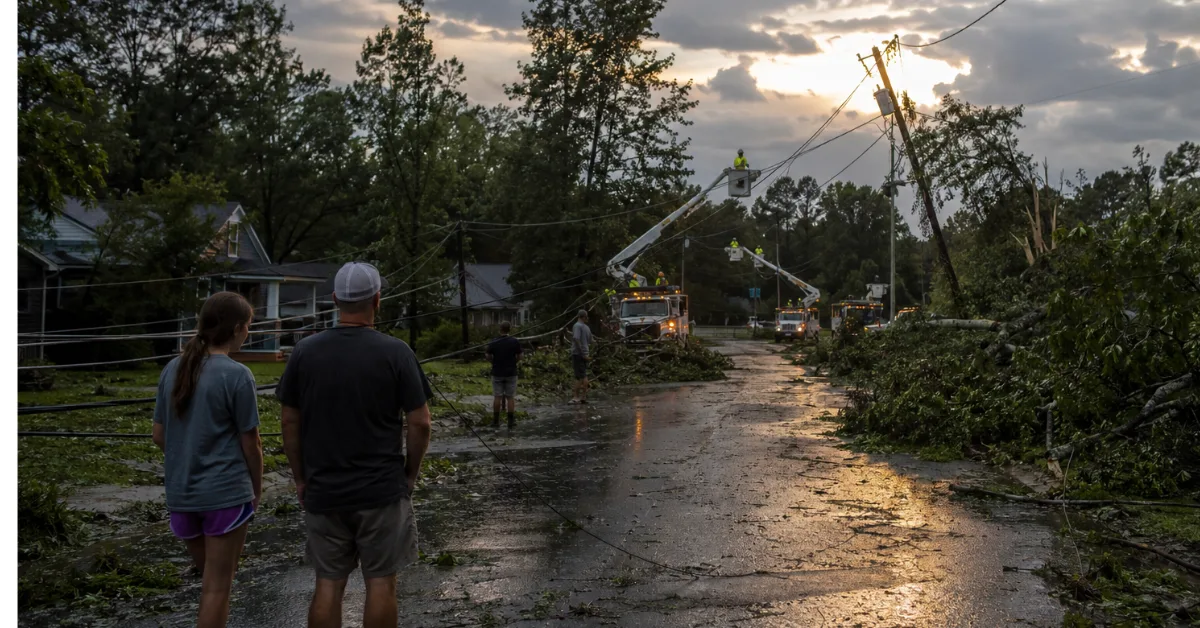
The sky over the Carolinas darkened within minutes on Tuesday evening – and then the chaos began. Severe thunderstorms swept across North and South Carolina on 28 July 2026, throwing branches and trees onto power lines and leaving tens of thousands of homes and businesses without electricity. What had begun as a muggy summer day ended for many families with dark houses, silent air-conditioning systems and the anxious question of when power would return.
According to regional television station WBTV, Duke Energy was reporting more than 42,000 customer outages across the two states at about 10 p.m. Several thousand of them were in the Asheville and Mooresville areas of North Carolina. Earlier in the evening, more than 28,000 customers had already been without power. The total rose sharply as further storm cells moved through the region.
The Asheville area was hit particularly hard. Local news service 828newsNOW reported 31,526 customers without electricity and 777 active outage locations on Duke Energy’s network at about 8:51 p.m. Roughly 10,000 outages were concentrated in the greater Asheville area alone. Affected communities included North Asheville, Alexander, Leicester, Biltmore Village and Weaverville, as well as areas along Tunnel Road, Cane Creek Road and the Oakley neighbourhood.
For the technicians, a long night was beginning. Duke Energy said crews first had to assess the damage and determine whether fallen trees, branches or other obstacles were blocking access to damaged lines. The company was initially unable to provide a reliable time for complete restoration. Repairing one line achieves little when additional damage remains hidden farther along the network.
Warnings ahead of the storms had mentioned powerful wind gusts of more than 60 miles per hour, large hail and the possibility of isolated tornadoes. After the storms, however, the most immediate danger came from fallen or sagging power lines. Utilities strongly warned people not to approach lines, trees or objects that might be in contact with them. Even cables that appear dead can still be energised.
By the morning of 29 July, conditions had improved, but they were far from normal. PowerOutage.us was still recording more than 17,000 homes and businesses without electricity in North Carolina. Buncombe County, which includes Asheville, had the highest number of outages in the state at that time. Duke Energy alone still had more than 12,000 affected customers.
This shows that a large outage figure does not represent one single fault. Hundreds of separate problem locations must be inspected, cleared and repaired. Some customers regain electricity quickly, while only a few streets away damaged poles or lines can continue causing problems for hours. That is why the numbers may fall rapidly even though the crisis is not over for everyone.
For many residents, the disruption meant a second night, or at least a difficult morning, without light, internet, refrigeration or air conditioning. In summer heat, a power cut lasting several hours can quickly become a health problem. At the same time, blocked roads and damaged lines make the work harder for the crews trying to restore electricity.
The storm front once again shows how quickly a regional weather event can hit tens of thousands of people at the same time. Only after the wind subsides does the true extent become visible: dark streets, dangerous cables, overstretched repair teams and households suddenly forced to improvise.
Source: WBTV, 828newsNOW, WLOS and PowerOutage.us, reports and grid data from 28 and 29 July 2026.
Latest updates
General
29.07.2026
Storm chaos in the Carolinas: More than 42,000 customers lose power
Severe thunderstorms struck North and South Carolina. At one point more than 42,000 homes and businesses were without electricity, especially around Asheville and Mooresville.