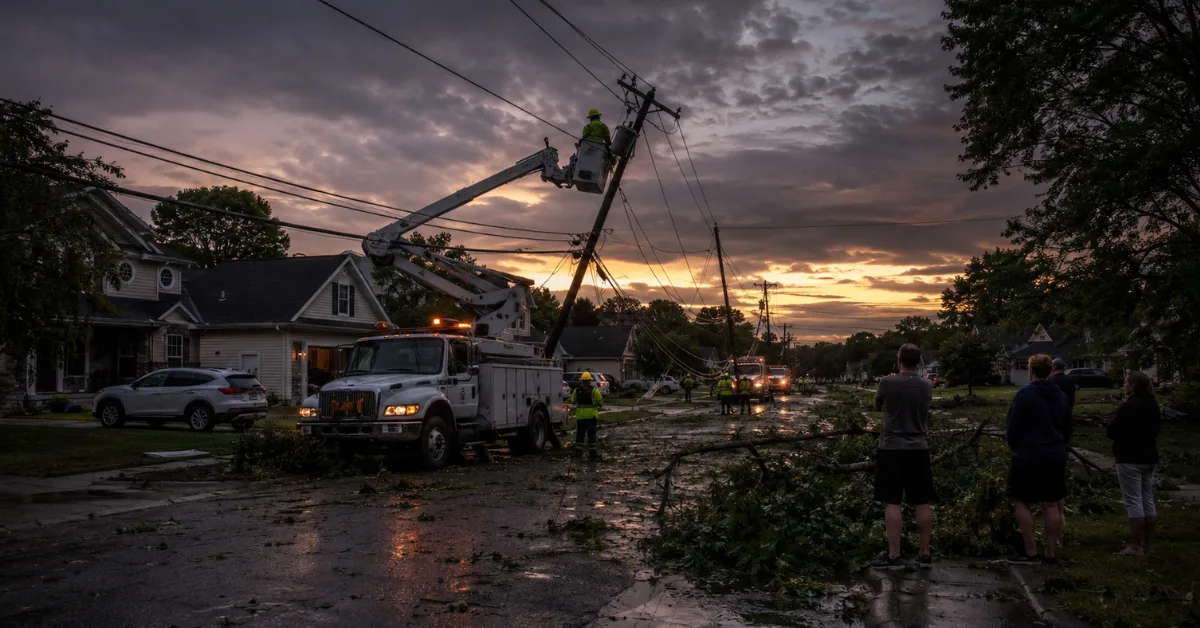
It was not a Hollywood blackout, but it still hit hundreds of thousands of people in the middle of everyday life: after a series of severe storms and extreme heat, more than 623,000 homes and businesses in the United States were without power on 6 July 2026. Pennsylvania and Michigan were hit especially hard. For many families, that meant dark refrigerators, phones on battery-saving mode, traffic lights out of service and one nervous question: when will the lights finally come back on?
According to Reuters, citing PowerOutage.us, Pennsylvania reported around 119,300 electricity customers affected. In the service area of PPL Electric Utilities alone, almost 80,000 connections were without supply at times. In Michigan, outages affected about 110,060 customers, including more than 82,000 in DTE Energy's area. This was not about a few flickering lamps, but about serious damage to lines, poles and local infrastructure.
The cause was a dangerous mixture of heat, thunderstorms, heavy rain and wind. That combination is treacherous: heat pushes electricity demand higher through air conditioning, while storms and branches attack the distribution grid at the same time. If roads are blocked as well, repair crews move more slowly. A short interruption can quickly become a night without refrigeration, light and internet.
The New York area was not spared either. Con Edison said it had already restored service to more than 166,800 of about 173,700 affected customers. Westchester County, including cities such as Yonkers, Mount Vernon, Rye and New Rochelle, was especially affected. At the same time, the live map from PowerOutage.us still showed almost half a million electricity customers without supply across the United States on Monday. These figures change constantly, but the message is uncomfortable: the grid is under pressure.
In Connecticut, the consequences of the holiday storms were also clearly visible. Local media reported that outages there temporarily rose to about 100,000, while tens of thousands of connections were still without power on Monday morning. In some towns, almost every second household was affected, and in Salisbury the share was even higher. Some customers were not expected to get power back until Tuesday evening.
For blackout preparedness, this event is a very clear warning signal. It does not take a total nationwide blackout for daily life to tip over. A damaged substation, a fallen tree, an overloaded line or a series of thunderstorms can be enough. Anyone who then has water, a torch, a power bank, a battery radio, simple food and a plan for cooling and communication is not panicking, but able to act.
The lesson from this US weekend is simple: power outages do not only happen in disaster films. They happen on holidays, during heat, after thunderstorms and often exactly when no one expects them. Today it is Pennsylvania, Michigan, New York or Connecticut. Tomorrow it could be any other region.
Source: Reuters, PowerOutage.us, CT Insider and NBC Connecticut, as of 6 July 2026.
Latest updates
General
06.07.2026
Over 623,000 without power: extreme weather hits parts of the US
After severe storms and extreme heat, more than 623,000 homes and businesses in the United States were without electricity. Pennsylvania, Michigan, New York and Connecticut were among the hardest-hit areas.