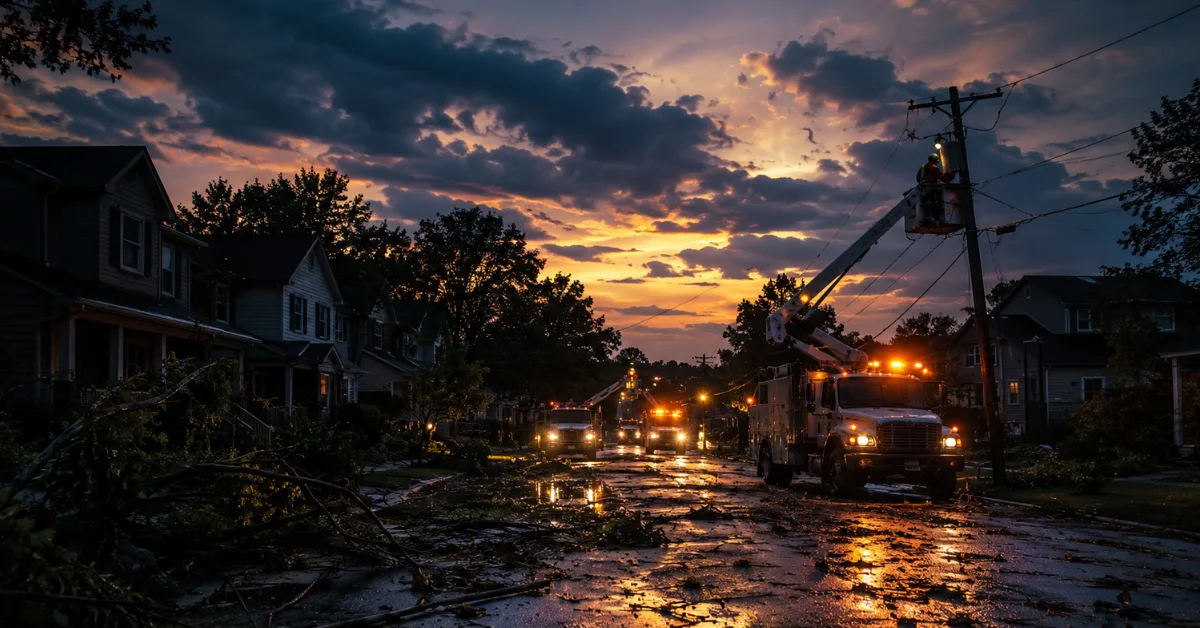
A holiday, a storm, a heatwave – and suddenly hundreds of thousands of households were sitting in the dark. In the United States, severe thunderstorms around 4 July, 2026 triggered massive power cuts across several states. The Northeast and parts of the Midwest were especially affected. While many people were celebrating, emergency crews were dealing with fallen trees, damaged power lines and roads where traffic lights and street lighting failed.
According to ABC News, nearly 779,000 households were without electricity at times on Saturday. That number describes connections, not people. The real number of affected residents was likely much higher. The most dangerous detail was the timing: the outages hit during a period of extreme heat. That combination is risky for ordinary households. Without power, fans, air conditioners, routers, chargers, lifts, electric garage doors and sometimes even parts of the water supply no longer work as expected.
Connecticut was hit especially hard after the severe thunderstorms on Saturday evening. There, outage numbers rose to around 100,000 at one point. On Sunday, tens of thousands of connections were still without service. Eversource alone reported more than 62,000 outages early Sunday afternoon. Towns such as New Britain, Bristol and Torrington each had several thousand customers affected. For many families that meant no lights, no cooling and no reliable way to charge a phone – right in the middle of muggy summer hours.
The Hudson Valley in New York State also faced a serious situation. More than 82,000 people lost power on Saturday evening, with Dutchess County hit particularly hard. The National Weather Service reported widespread damage south of Albany. The problem was not just one storm. Local reports said it was already the third time in one week that thousands of people in parts of New York State had been left without electricity.
From a distance, numbers like these sound abstract. In daily life they look very different: intersections without traffic lights, refrigerators slowly warming up, older people in overheated apartments and families who do not know when power will return. This is where preparedness separates itself from improvisation.
For Blackout-Tip, this incident is more than another weather report. It shows how quickly a normal holiday can become a real stress test for modern households. Many people only notice in the dark how much daily life depends on small things: a charged phone, a working torch, drinking water, a battery-powered radio, some cash and food that does not require a cooker.
This was not a nationwide total blackout. But it is exactly the kind of situation that happens most often in real life: local, chaotic, hot, uncomfortable and much harder than expected for unprepared households. Anyone who starts looking for batteries, a power bank or water only after the lights are out loses valuable time.
The lesson from the United States is simple: power cut preparedness is not only for winter, snow and major disasters. A summer storm alone can be enough to throw hundreds of thousands of households off balance within minutes.
Source: ABC News, CT Insider and Times Union, 4 July–5, 2026.
Incidents & analysis
General
05.07.2026
USA in the dark: storms and heat knock hundreds of thousands offline
Severe thunderstorms and extreme heat triggered massive power cuts across several US states around 4 July. The incident shows how fast a holiday can turn into a household stress test.