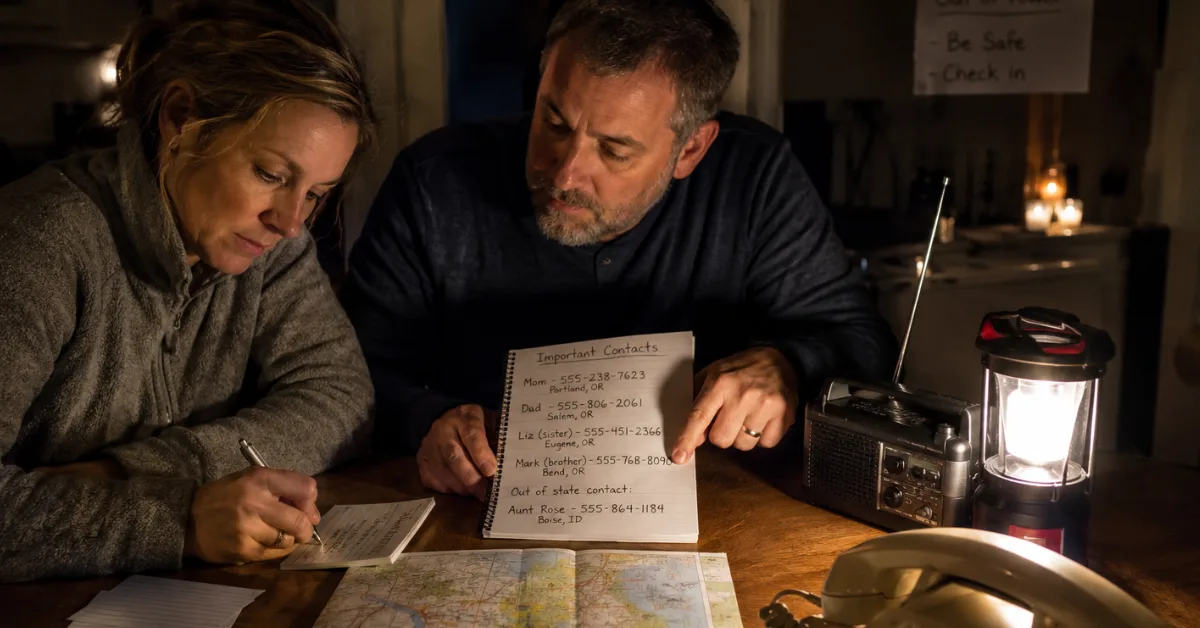
When the mobile network fails, a phone battery is empty or relatives do not have a telephone, driving around in a panic will not help. Reliable contact starts before the blackout with a simple analogue communication chain. Its purpose is not to reach every person directly at once. What matters is that information can be collected, passed on and checked in an orderly way.
First, choose one central trusted person who ideally lives outside your local area. This person acts as the collection point for messages if individual family members briefly gain access to a landline, somebody else’s telephone or another working connection. Each person reports only their condition, current location and next planned step. This prevents five people from trying to reach one another at the same time. The trusted contact keeps a list and reduces contradictory information.
Every person involved also needs a small paper contact card. It should contain their full name, home address, two local contacts, one contact outside the region, important medical notes and the agreed reporting times. Children, older people and relatives who need support should always carry the card. Keep one copy in the household emergency folder and another with a trusted neighbour.
Ask schools, care facilities, workplaces and day-care providers in advance how they will operate during a prolonged communications failure. Write down collection authorisations, alternative locations and named contacts. Do not automatically travel to every facility: uncoordinated collection attempts can block roads and place additional pressure on staff. Police, fire and emergency call centres are not private message services and should be contacted only for genuine emergencies.
Set fixed reporting windows, for example at 9 am, 2 pm and 7 pm. A person without a telephone reports at those times to a previously agreed safe message point, such as a relative’s home, a known neighbour, a workplace or a staffed care facility. The location must be accessible but must not lie inside a hazard area. Do not leave openly readable notes on the front door. A sealed envelope, a labelled compartment or personal delivery to a named trusted person is safer.
Use the same short format for every message: name, date, time, current location, health status and next step. For example: “Anna, 2 pm, at Aunt Maria’s, unhurt, staying there until 7 pm.” Long explanations create mistakes. Record only confirmed information and clearly mark uncertain details as unconfirmed.
Check whether a corded landline telephone is available. Cordless phones usually do not work without electricity, and even a traditional landline may fail depending on the network technology. It is therefore an extra option, not a guaranteed replacement. Two-way radios can help over short distances if range, batteries, channel and permitted use have been clarified beforehand. Agree fixed radio times instead of leaving the device switched on continuously.
Use a messenger only when the route is safe and the message is genuinely important. Nobody should drive or walk merely to ask a question through flooding, storms, darkness, failed traffic lights or areas with fallen power lines. Messengers should not travel alone where possible, should carry the message in writing and should state an expected return time.
Test the communication chain twice a year. For the exercise, switch off all mobile phones and check whether messages actually arrive. Update addresses, carers, medicines and reporting locations. A good plan does not replace a phone, but it prevents a family from searching, waiting and following false rumours at the same time during an outage.
Sources: Ready.gov, Family Emergency Communication Plan and Make a Plan; American Red Cross, Disaster Preparedness Plan and Emergency Contact Card.
Guides
General
31.07.2026
Staying in contact without a mobile: An analogue blackout communication chain
When mobile networks and the internet fail, paper cards, fixed check-in times, trusted contacts and safe message points help families reconnect.