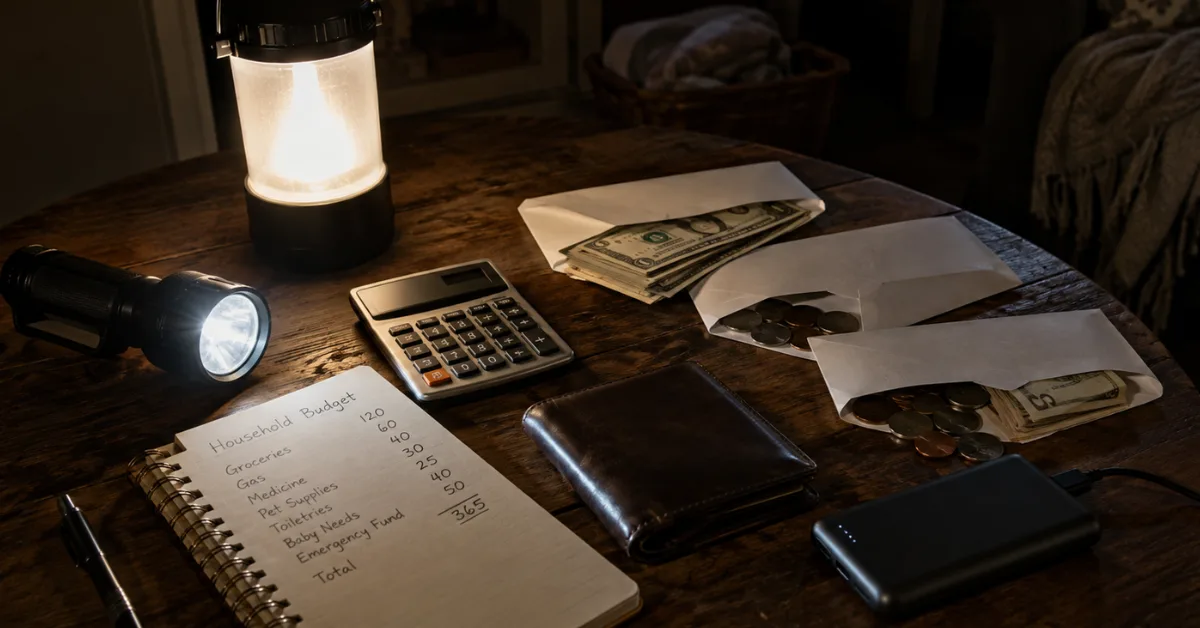
During a blackout, money may exist but still become unusable. Card terminals, ATMs, online banking, payment apps and electronic cash registers require electricity, data connections or functioning data centres. A household should therefore do more than keep “some cash” and should establish a clear payment plan in advance.
First calculate a realistic requirement. List what your household may still need to buy for ten to fourteen days: drinking water, simple food, medicines, hygiene products, fuel or essential transport. Multiply the estimated daily amount by the chosen preparedness period and add a small reserve. The right total differs for every household. The aim is not to hoard large sums but to bridge necessary expenses.
A practical method is to divide the money among four labeled envelopes. Envelope one is for food and water. Envelope two covers medicines, hygiene and essential transport. Envelope three contains small amounts for communication, help between neighbors or unexpected errands. Envelope four remains closed as a reserve and is opened only when the other amounts are insufficient. This prevents too much being spent on the first day.
Use mostly low-value notes and some coins. When cash registers are down or change is scarce, traders may be unable to break large notes. A mixture that allows small purchases to be paid as exactly as possible is therefore more useful than a few high-value notes. Check regularly that the notes remain valid and undamaged.
Store the emergency cash somewhere dry, discreet and out of children’s reach. Do not keep the entire amount in one wallet. A small part can remain readily accessible, while the rest is placed in a second secure location. Do not write the exact hiding place on an openly accessible checklist, and do not tell people outside the household how much cash is stored.
Cash is the most important technical fallback, but it is not the only payment option. Debit and credit cards remain useful if individual shops have backup power or temporarily functioning connections. Do not, however, rely on contactless payment by phone or smartwatch: the battery, mobile network, internet connection or authorization process may fail. Do not wait until the power is already off before withdrawing cash.
Use a clear order of priority during the blackout. Buy first what protects health and basic supplies. Avoid panic buying and do not pay heavily inflated prices unless there is an immediate emergency. Count change straight away and, where possible, ask for a handwritten receipt showing the date, goods, amount and seller’s name.
If a service already received cannot be paid for immediately, seek a calm written arrangement. The amount, date, contact details and later payment method can be recorded on a receipt and signed by both sides. The legal position varies by country; such a note is not universal legal advice, but it helps prevent misunderstandings.
Be particularly cautious of supposed helpers, mobile money changers or people who promise access to bank accounts, fuel or preferential supplies in exchange for cash. Never disclose a PIN, security code, password or full card details. Do not display your entire cash reserve while paying.
Once the systems return, check bank and card activity for duplicate or unknown transactions. Settle outstanding amounts agreed in writing, replenish the emergency fund and adjust the envelope allocation according to what you actually spent.
Sources: Austrian Civil Protection Association, Bargeld für alle Fälle; Deutsche Bundesbank, closing speech at the Cash Symposium; Austrian Federal Ministry, frequently asked questions on blackouts and the law.
Guides
General
04.08.2026
Paying during a blackout: A four-envelope emergency cash plan
Four separate cash envelopes, small bills and clear shopping priorities help you keep paying when cards, ATMs and digital banking fail.