When the lights, router and refrigerator go off at the same time, people quickly use the word blackout. Yet not every power cut is a blackout. The cause is often limited to your own home, the building or a small part of the local distribution network. During the first few minutes, the final scale may still be impossible to confirm. A calm check can nevertheless show whether the problem is probably minor or whether a wider emergency is developing.
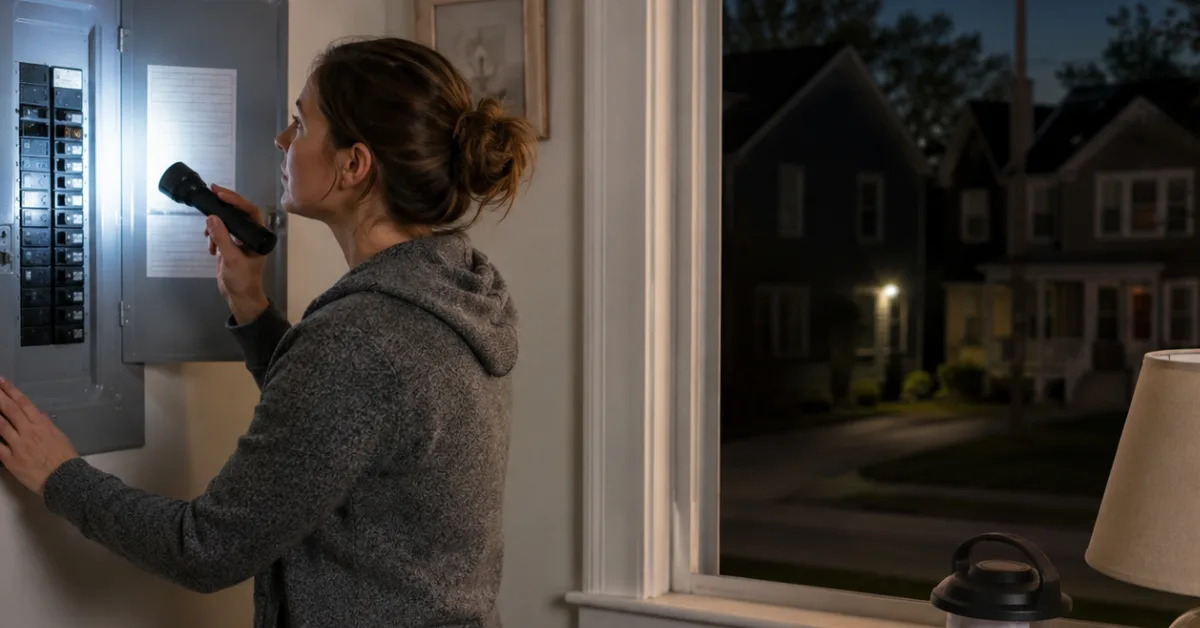
Take a flashlight first and establish exactly what has stopped working. If only one socket, one room or one appliance has failed, the problem is probably within your own electrical circuit. Check fuses and the residual-current device only when there is no smoke, burning smell, water, sparking or damaged cable. If a breaker trips again immediately, leave it off, disconnect suspicious appliances and obtain professional help. Repeatedly resetting it can be dangerous.
If the whole home is dark, look through a safe window or ask neighbors. If other apartments in the building still have electricity, the fault probably affects only your connection or electrical installation. If the entire building, nearby properties and street lighting are also dark, a network fault is more likely. Do not go outside unnecessarily and never approach fallen cables, damaged poles or equipment that is sparking.
Next, check reliable information sources. Use the utility's outage page or app, notices from the local government, police or civil protection services, and a battery-powered or wind-up radio. A dead Wi-Fi router does not prove that there is a blackout. A working mobile phone does not prove that the grid is stable either, because mobile sites may continue on batteries or emergency generators. Conserve battery power.
Several simultaneous signs suggest a larger incident: outages reported across different districts or towns, dark traffic lights and shops, stopped trains, problems with mobile networks or the internet, closed gas stations and ATMs, and official notices that provide no short restoration time. No single sign proves a blackout. The important factors are geographical reach, expected duration and the failure of additional infrastructure.
Do not rely on water still coming from the tap. Water networks may have stored pressure, elevated reservoirs or emergency power and may initially continue working. Conversely, a local pumping failure can interrupt water even while electricity remains available elsewhere. Judge the overall situation rather than one appliance or service.
Use a simple 15-minute routine: check your home and breaker panel first, then the building and immediate neighbourhood. After that, seek official information. If there is no confirmed short repair time or other systems begin to fail, treat the situation cautiously as a prolonged outage. Switch off unnecessary appliances, unplug sensitive electronics and leave one lamp switched on so you notice when power returns.
Keep the refrigerator and freezer closed, fill clean water containers while the supply is still safe, and switch early to radio and prepared contact lists. Check whether children, older people, neighbors or anyone relying on electrically powered medical equipment needs help. Do not wait for authorities to use the specific word blackout. Sensible precautions begin as soon as the duration and scale are uncertain.
In ordinary usage, a blackout is a widespread and prolonged failure of the electricity grid that also affects other essential services. You can rarely confirm one beyond doubt in the first minute. You can, however, recognize when an ordinary power cut is escalating: the fault extends beyond your building, several infrastructures fail and rapid restoration is not in sight. At that point, the label matters less than calm and early action.
Sources: Stromnetz Berlin, self-check guidance for power failures; BKW Energie AG, guidance on power interruptions and network faults; German Federal Office of Civil Protection and Disaster Assistance, information on prolonged power outages.
Guides
General
21.07.2026
Power outage or blackout? How to recognize what is really happening
A dark home does not automatically mean a blackout. A calm 15-minute check helps you determine whether the problem is local or affects a much wider area.