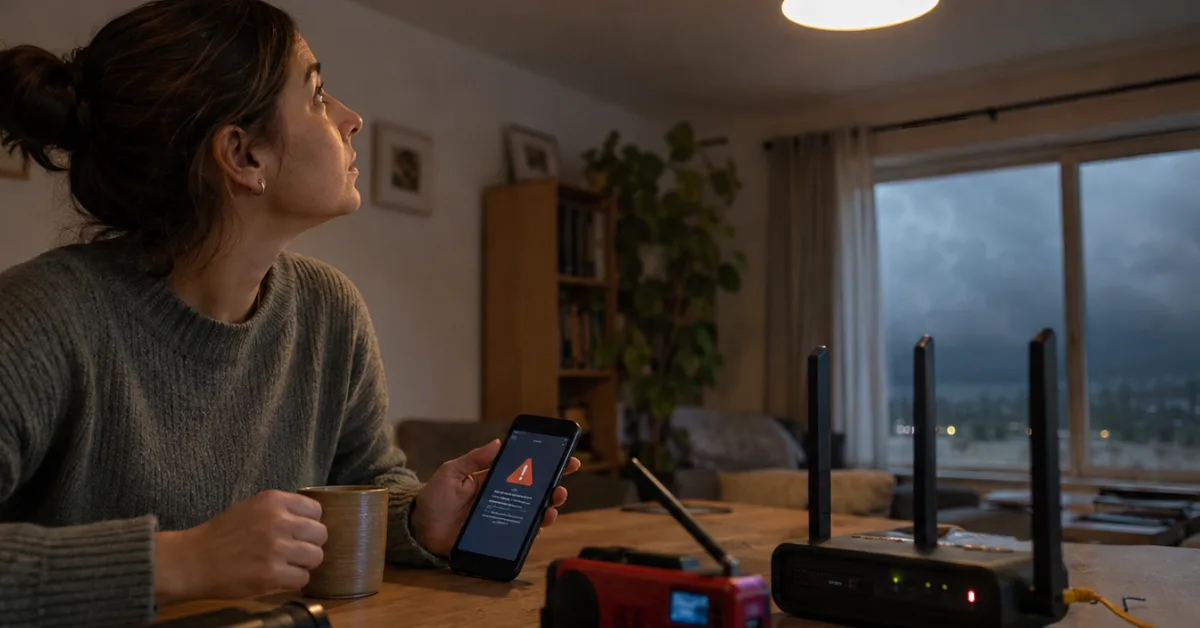
A major blackout often gives households no reliable advance warning. That is the most important fact to understand. One flickering light, slow internet or a tripped circuit breaker does not prove that the grid is about to collapse. There are, however, signs which, when they appear together, can point to a serious disturbance or a higher risk of an outage. Anyone who interprets these signals correctly can use the final minutes sensibly without panicking.
First, watch for repeated short interruptions. If lights flicker in several rooms at the same time, appliances restart repeatedly or the electricity goes off and on again at short intervals, there may be a fault in the building connection or the local network. Ask a neighbor whether the same thing is happening there. If only your home is affected, check the breaker panel without removing covers or touching electrical parts. If you smell burning, hear crackling or notice an unusually hot connection, contact the network fault service or a qualified electrician.
A stronger warning sign is when several independent systems develop problems at the same time. Street lights and traffic lights go out, shops lose power, mobile service or internet becomes unstable, and trains or water pumps report disruptions. This does not automatically mean that a blackout is starting. It does suggest that the problem is probably larger than one circuit breaker or one faulty appliance.
Official messages deserve particular attention. Warnings from the network operator, announced load shedding, requests to reduce electricity use, government alerts or notices of a tight supply situation carry more weight than rumours on social media. Save the outage page and telephone number of your local network operator in advance. Do not depend on a single app, because mobile and internet networks can quickly become overloaded during a large outage.
Weather can also increase the risk. Severe thunderstorms, storms, ice, flooding, wildfires, and extreme heat or cold can damage lines or sharply increase demand. A severe-weather warning is not proof that a blackout will occur. It is a reason to check charge levels, flashlights, radio, water and important medications.
If power repeatedly switches off and returns for only a few minutes, treat the supply as unstable. Do not use a elevator. Stop hazardous work, switch off the stove, iron, electric heaters and tools, and disconnect sensitive electronics where possible. Leave one lamp switched on so that you notice when the supply returns steadily.
Use a credible warning for a fixed ten-minute plan, not for frantic shopping. Inform everyone in the household, put flashlights and a radio within reach, fill existing drinking-water containers while the water supply is still working safely, and charge essential devices. Check whether medical equipment has backup power. Close fridges and freezers and avoid opening them afterwards.
Do not confuse technical warning signs with certainty. Flickering lights can also be caused by a loose connection inside a building and may themselves indicate a fire risk. Frequent voltage drops should be reported and checked by professionals. Never inspect distribution cabinets, service connections, damaged cables or transformers yourself. Stay away from fallen or hanging wires and report them immediately.
If the electricity finally fails, calmly check the scale of the problem: Are the circuit breakers in order? Do neighbors still have power? Are street lights working? Has the network operator issued a notice? A local fault and a wide-area blackout both begin with darkness for you, but they create very different expectations about duration and assistance.
The best response to possible warning signs is not prediction but readiness. One signal may be harmless. Several simultaneous failures, official warnings and extreme conditions deserve attention. Starting a prepared routine at that point protects equipment, saves time and keeps you able to act, even if the warning later turns out to be a false alarm.
Sources: GOV.UK Prepare, guidance on power cuts and possible rotating emergency disconnections; Ofgem, planning for a power cut; ESB Networks, guidance on flickering lights and low supply voltage; German Federal Government, risk analysis of wide-area power outages.
Guides
General
22.07.2026
Spot a blackout before everything goes dark: Warning signs that matter
A blackout can rarely be predicted with certainty, but several simultaneous failures, official warnings, and extreme weather can provide useful clues.