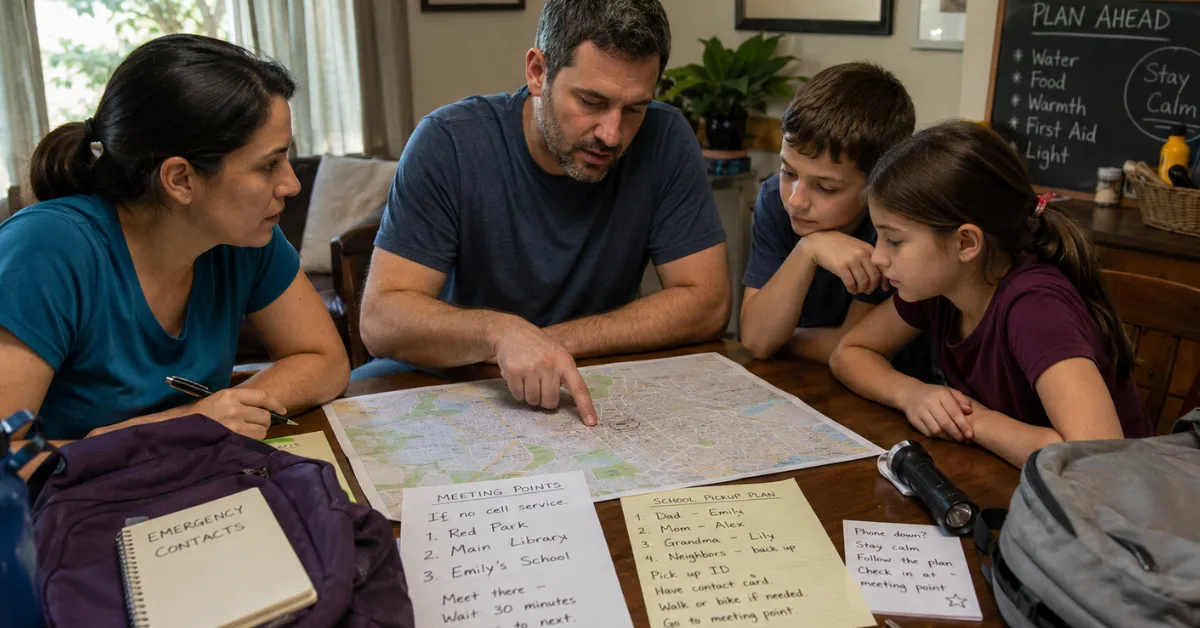
When a major power outage also brings down cell networks and the internet, the greatest confusion often develops away from home. Parents are at work, children are at school or daycare, a relative may be at a medical appointment, and nobody knows who should travel where. A meeting-point plan agreed on in advance prevents several people from setting off at once, children from being picked up twice, or family members from spending hours searching past one another.
Start with a simple overview: where is each person on a normal workday? Write down schools, daycare centers, workplaces, care facilities and regular routes. Then decide who is responsible for each person when communications are unavailable. The plan must contain actual names. “Someone will pick up the children” is not a rule. “Maria picks up Luis from school first and then Ana from daycare” is a clear assignment.
Children need a fixed pickup chain. Name one primary person, a first backup and a second backup. All of them must be officially registered with the school or childcare provider as authorized pickup persons and know which identification is required. Ask the institution directly whether children remain inside during a power or network failure, are moved to an assembly point, or are released only through a particular procedure. The family plan must never override the school’s rules.
Agree on three meeting points. Point A is close to home and applies when the building can be reached safely. Point B is outside the neighborhood and is used when roads are closed, homes are evacuated or access routes are blocked. Point C is a familiar address in another part of town or a nearby community. Every location must be precise. “At the park” is too vague; “at the main entrance of the public library beneath the large sign” is much better.
Also decide when the plan begins. One sensible rule might be: if the phone network remains unavailable and contact is still impossible after several attempts, everyone automatically carries out their assigned task. Nobody changes the meeting point spontaneously. Anyone who must leave a location places a brief note at the agreed secure message point, giving their name, time, destination and companions. Do not display this information openly on the front door.
Plan routes that do not depend on a car, traffic lights, elevators or public transportation. Mark a main route and an alternative on a paper map. Check which trip is also possible on foot and where bridges, tunnels or heavily traveled roads could become difficult. People with limited mobility, older relatives and pets need a named person responsible for them. Otherwise they can easily be overlooked in a general family plan.
Each person should carry a small emergency card. It should list the three meeting points, pickup order, two important contacts and any essential medical information. A child’s card should contain the child’s full name, the names of parents or guardians and the people authorized to pick them up. Avoid unnecessary sensitive data. Keep the card in a backpack, wallet or jacket so it remains readable without a charged device.
Children must understand what to do in a way appropriate for their age: remain at school or daycare, follow staff instructions and leave only with an agreed and authorized person. They should not walk alone to the family meeting point unless this has been specifically planned for their age, the route and local conditions. A family password may provide extra reassurance, but it never replaces the institution’s identity checks.
Test the plan at least twice a year. Walk the routes, verify pickup authorizations and update workplaces, phone numbers and meeting points. A good reunification plan is not complicated. It simply answers four questions clearly: who picks up whom? Where does each person go? When does the plan start? What happens if the first route or meeting point does not work?
Guides
General
18.07.2026
Meeting points, not phone chaos: how your family can reunite
When cell networks and the internet fail, every family needs fixed meeting points and clear responsibilities. This plan decides who picks up the children, where everyone goes and what happens if the first route is blocked.