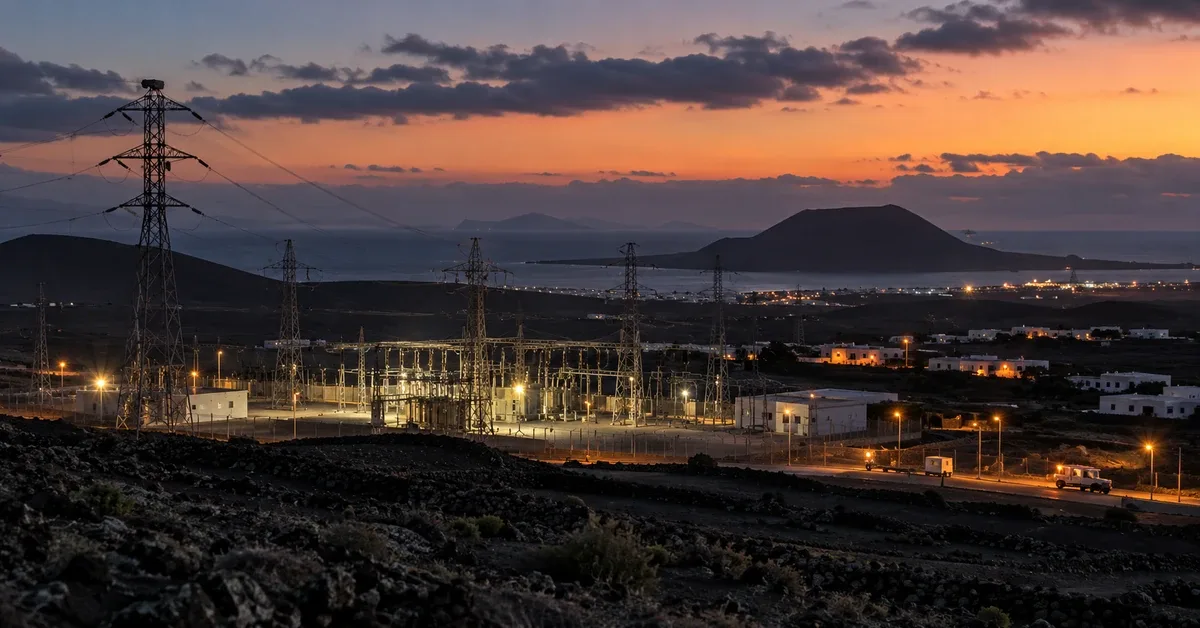
A major power failure hit almost all of Lanzarote early on Saturday, 3 October 2026. The Canary Islands government explicitly described the event as a “cero energético”, a near-total loss of electricity supply. Official information says the incident began at 05:44 in the 66 kV network at the Mácher substation in Tías. About 51,703 customers initially lost power. Only four minutes later, while restoration manoeuvres were under way, another incident occurred at the San Bartolomé and Punta Grande substations. Generation was lost and the number of affected connections rose to about 73,600.
Playa Blanca in the south was an important exception because it remained supplied through its connection with Fuerteventura. Elsewhere, restoration proceeded gradually. At 06:47 around 39,000 customers were still without electricity; later the number fell to about 8,463. By around 07:13 Endesa reported that service on its distribution network was almost completely restored. The exact cause of the original failure remained under investigation.
The consequences went beyond lights and household appliances. The outage also stopped seawater desalination plants that are essential for drinking-water production on Lanzarote and La Graciosa. An electrical fault therefore became a problem for a second critical service within minutes. Water operators had to protect stored reserves and manage distribution, and authorities warned of temporary interruptions and low pressure even after electricity had largely returned.
The Canary Islands Directorate-General for Emergencies activated the PLATECA civil-protection pre-alert at 07:15. The aim was to monitor developments, coordinate authorities and emergency organisations, and assess possible effects on essential services. Residents were asked to follow official information and use water responsibly until production and distribution were fully stable.
The water impact is what makes this incident especially relevant for blackout preparedness. A power outage does not necessarily end for a household when the lights come back. Pumps, booster stations, desalination, treatment systems and storage facilities may need controlled restarts. In island grids or places with electricity-dependent water systems, the consequences can last longer than the electrical interruption itself.
For households, the lesson is practical: drinking water is not a reserve that matters only after several days. If pumps or production stop, the tap may deliver little or no water even after power returns. A sensible stored supply, clean containers and restrained use during the first hours provide valuable time without panic buying.
The Lanzarote blackout was restored relatively quickly. Precisely for that reason it clearly demonstrates how tightly modern infrastructure is connected. A technical fault in the power grid can affect water, communications, transport and other services within minutes. Preparedness therefore means more than spare lighting and power banks; it also means understanding which everyday services depend indirectly on electricity.
Sources: Government of the Canary Islands, EFE, Endesa and reports on Lanzarote water supply. Updated: 4 October 2026.
Latest updates
General
04.10.2026
Lanzarote blackout hits about 73,600 customers and stops drinking-water production
Lanzarote blackout hits about 73,600 customers and stops drinking-water production