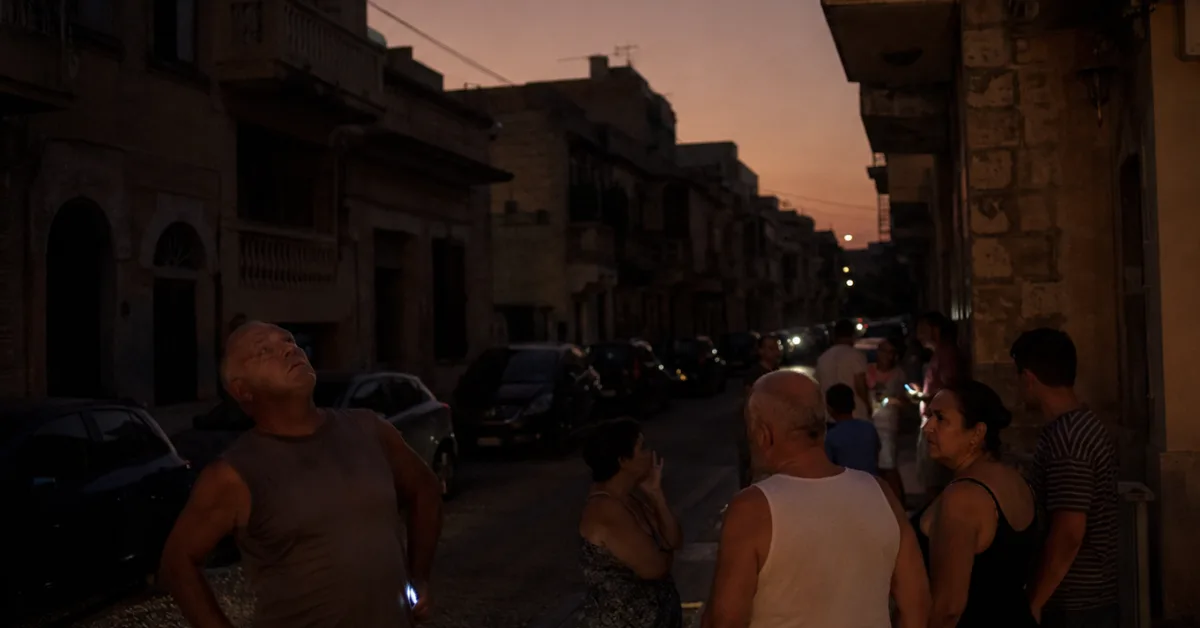
Malta has endured an uneasy tropical night. Even after sunset, the heat barely eased, while the lights suddenly went out in numerous localities. From Monday evening into Tuesday morning, residents reported power cuts lasting for hours. Some areas regained supply after a few hours, while others had to wait until morning without fans, air conditioning, refrigeration or reliable internet access.
According to Maltese media reports, affected areas included Sliema, Iklin, Pembroke, Santa Venera, St Julian’s, Ħamrun, Baħrija, Fgura, Birkirkara, Marsa and Naxxar. Outages were also reported across large parts of Birgu and Bormla. This was not a complete nationwide blackout, but the number of localities affected at the same time made the night feel like a much larger grid failure for many households.
The timing made the disruption especially difficult. Malta is in the middle of an intense heatwave, and homes often remain extremely hot even at night. When the electricity fails, fans and air-conditioning units stop immediately. For older people, young children, those who are ill and anyone living in poorly ventilated rooms, a technical fault can quickly become a health burden. Refrigerated medicines and temperature-sensitive food are also put at risk during prolonged outages.
Energy Minister Miriam Dalli said extreme temperatures had coincided with record electricity demand. At the same time, several faults were reported in the distribution network. Enemalta had already identified four separate cable faults on Monday, affecting areas including Birkirkara, Balzan and Iklin. Mobile generators were deployed while technicians worked to locate the damaged cables, reroute supply and carry out repairs.
That combination is dangerous for any power network. High temperatures increase demand for cooling while cables, transformers and other components are themselves placed under greater stress. If several local faults then occur at almost the same time, reserves and alternative supply routes may not be sufficient everywhere. One fault can remain contained; several faults during a demand peak can leave entire neighbourhoods without electricity for hours.
For many residents, the result was a sleepless night. Dark streets, unusable appliances and uncertainty over how long the outage would last caused frustration. The situation becomes more serious if mobile networks, internet routers or electric water pumps weaken or fail as well. Then people lose not only comfort but also information. Without knowing whether an outage will last ten minutes or ten hours, it is difficult to manage food, battery power and medical needs sensibly.
The incident is another reminder that summer power cuts are not less dangerous than winter outages. Cold may not be the main concern, but the risks of overheating, dehydration and spoiled food increase. Households should keep drinking water, charged power banks, battery lighting and a plan for heat-sensitive people ready. Refrigerators and freezers should remain closed as much as possible during an outage.
Small shops, restaurants and pharmacies also come under pressure quickly during longer interruptions. Card payments, refrigeration, lighting and till systems all depend on electricity. Even where generators are available, fuel and output are limited. Every additional outage therefore extends the chain of disruption.
Malta was not plunged entirely into darkness. However, the series of outages shows how quickly heat, high demand and technical damage can push a modern grid towards its limits. As repair teams gradually restored supply, many residents were left with an uncomfortable conclusion: on a hot night, only a few damaged cables may be enough to turn ordinary life into an emergency.
Source: MaltaToday, Newsbook Malta, Lovin Malta and Enemalta. Information current as of 22 July 2026.
Latest updates
General
22.07.2026
Malta swelters in the dark as heatwave and cable faults cause hours-long power cuts
Extreme heat, record electricity demand and several cable faults left numerous Maltese localities without power for hours. For many residents, a night without fans or air conditioning became an ordeal.