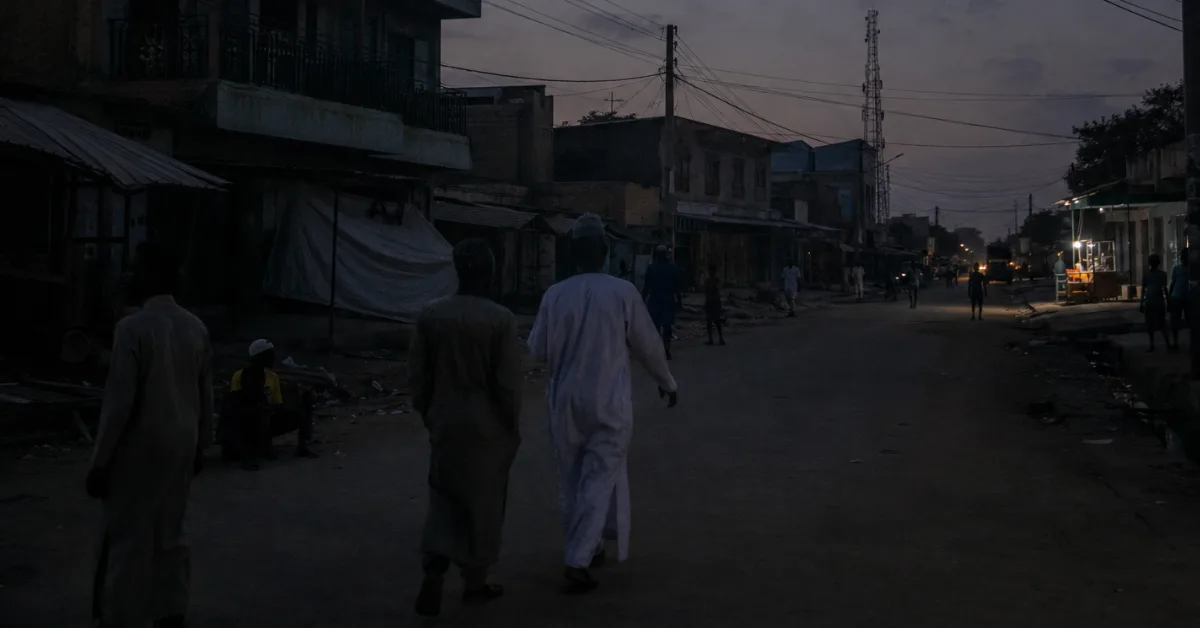
Northeastern Nigeria has endured a weekend in which the lights went out across several major cities at the same time. This time, however, the darkness was not caused by an unexpected grid collapse but by a previously announced construction project on the transmission network. From 9:00 a.m. on Saturday, 25 July 2026, until 5:00 p.m. on Sunday, 26 July, electricity supply was completely interrupted in Bauchi, Gombe, Damaturu, Maiduguri, Yola, Jalingo and many surrounding communities. For households, businesses and public institutions, that meant about 32 hours without normal grid power. As generators started up and solar batteries became the most important reserve, many residents had to reduce daily life to charging devices, keeping food cool, securing water and maintaining communication.
The Transmission Company of Nigeria, known as TCN, had announced the interruption in advance. Technicians were scheduled to install new optical ground wire, or OPGW, on the 330-kilovolt Jos–Bauchi–Gombe transmission line. These are protective earth wires containing fiber-optic cables. They help shield high-voltage lines from lightning while also allowing faster communication between substations, improved grid monitoring and earlier detection of technical faults.
The work required the Bauchi transmission substation, with voltage levels of 330, 132 and 33 kilovolts, to be temporarily taken out of service. As a result, the Yola Electricity Distribution Company and the Jos Electricity Distribution Company could not receive bulk electricity from the national grid during the operation. The result was a controlled but complete blackout throughout the affected supply areas.
Even an announced outage remains a severe test for an entire region. Households had to protect refrigeration, lighting and communication using batteries, solar systems or generators. Small businesses faced additional fuel costs, while shops selling refrigerated goods were under particular time pressure. Hospitals, water services, mobile phone installations and other essential facilities depended on working backup systems. If a generator failed or fuel ran out, scheduled maintenance could quickly turn into a serious supply emergency.
The duration made the situation especially significant. A short interruption can often be managed with flashlights and charged mobile phones. After 32 hours, however, cold chains, water pumps, payment terminals, cash machines and telecommunications become increasingly vulnerable. Petrol and diesel consumption also rises because many Nigerian households and companies operate their own generators. These additional costs hit small businesses and families hardest.
TCN said the work was necessary to make the transmission network more stable and efficient in the long term. The new fiber-optic technology is intended to help operators locate faults more quickly and coordinate protection systems more effectively. The upgrade could therefore help reduce unplanned and prolonged outages in the future. That did not change the immediate reality that the affected cities relied almost entirely on private and institutional backup power throughout the weekend.
The incident shows how dependent entire regions can be on a small number of central transmission links. When one such line is disconnected for work, electricity can disappear not only from individual streets but from several cities at once. Planned maintenance is unavoidable, but it reveals the importance of decentralized energy sources, reliable emergency power plans and timely information for residents and businesses.
Source: The Guardian Nigeria, “TCN announces 32-hour power outage across seven northeastern cities”, 18 July 2026; Daily Post Nigeria, “Planned power outage to plunge northeastern cities into two days of darkness”, 18 July 2026; Transmission Company of Nigeria, public notice on maintenance of the 330-kV Jos–Bauchi–Gombe line.
Latest updates
General
27.07.2026
32 hours without grid power: Northeast Nigeria goes dark
Several cities in northeastern Nigeria were completely cut off from normal grid electricity for 32 hours during major work on a central 330-kV transmission line.