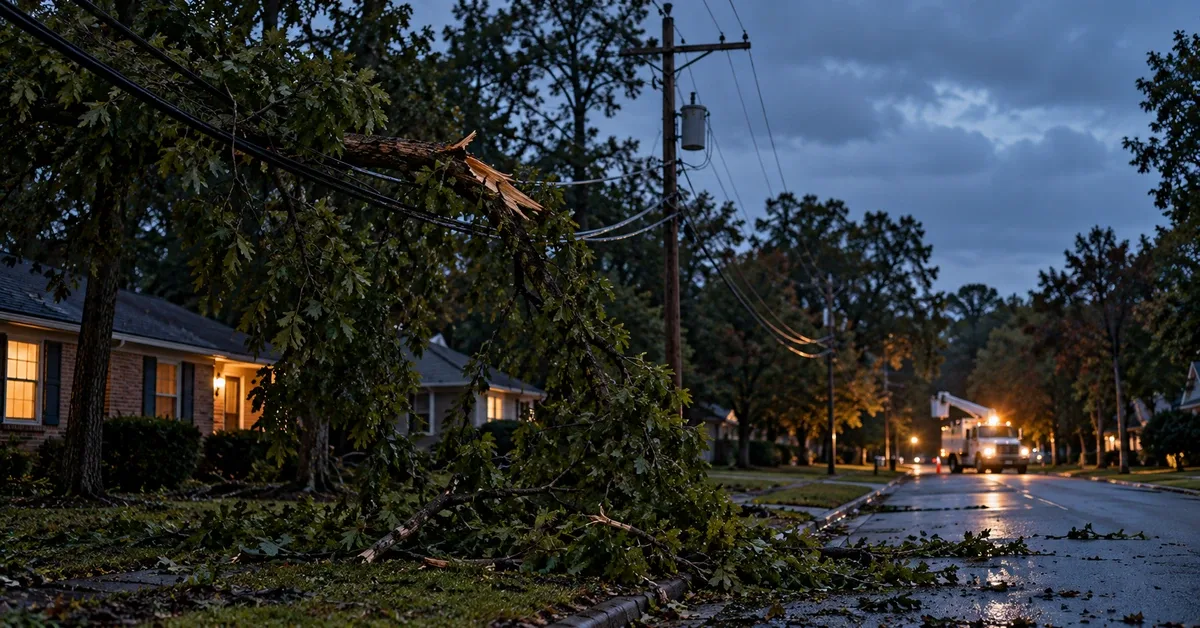
On Sunday, October 4, 2026, an unplanned power outage in northeast Raleigh, North Carolina, affected hundreds of homes and businesses. Duke Energy initially reported 571 customers without electricity. Publicly tracked outage data later showed the event growing to more than 1,100 affected customers before service was fully restored shortly after midnight.
Duke Energy said fallen trees or limbs had damaged electrical equipment. This was not a collapse of the wider regional grid, but a local distribution-network failure. That distinction makes the event especially useful for household preparedness: local outages happen far more often than nationwide blackouts, yet they can still leave individual neighborhoods without power for hours.
The first reports appeared on Sunday afternoon. The utility initially estimated restoration between 6:30 and 7:30 p.m. However, public outage tracking showed the incident expanding during the evening. At its peak, more than 1,100 connections were affected. The outage was recorded as fully resolved at 00:36 UTC on October 5. For some customers, the interruption therefore lasted several hours.
Trees are a familiar weak point for distribution networks. Strong gusts, saturated soil, dead branches or previously damaged trees can pull down conductors, damage poles, or strike transformers and other equipment. Even when the high-voltage system remains stable, one damaged local line can disconnect a substantial area. Repair crews must first secure the site, remove hazardous vegetation and then repair conductors or components.
The duration is not the only concern. Downed power lines can be immediately life-threatening. They should never be touched or driven over. Fences, vehicles, wet branches or metal objects near a damaged line may also become energized. Anyone who sees a downed conductor should keep well away, warn others and contact the utility or emergency services.
The Raleigh incident also demonstrates why realistic preparedness should not begin only with the idea of a multi-day national blackout. A few hours without electricity can disrupt lighting, internet access, refrigeration, electric garage doors, medical devices, pumps and cooking. Charged power banks, flashlights, a battery radio, drinking water and a clear family plan are often enough to remain calm and safe during a local outage.
The period after restoration matters as well. Appliances should be brought back into service deliberately. Refrigerators, routers and essential equipment can restart first, while high-power loads can follow with a short delay. This avoids an unnecessary surge inside the home.
Raleigh is not evidence that a major blackout is imminent. It is a typical, well-documented distribution outage with a practical lesson: local infrastructure damage can remove electricity for several hours without warning. A household prepared for this realistic scenario already has a strong foundation for dealing with larger and longer outages.
Sources: ABC11 Raleigh-Durham, Duke Energy and publicly tracked outage data. Updated October 5, 2026.
Latest updates
General
05.10.2026
Raleigh outage grows beyond 1,100 customers after trees damage equipment
A local Raleigh outage affected more than 1,100 connections after fallen trees or limbs damaged electrical equipment.