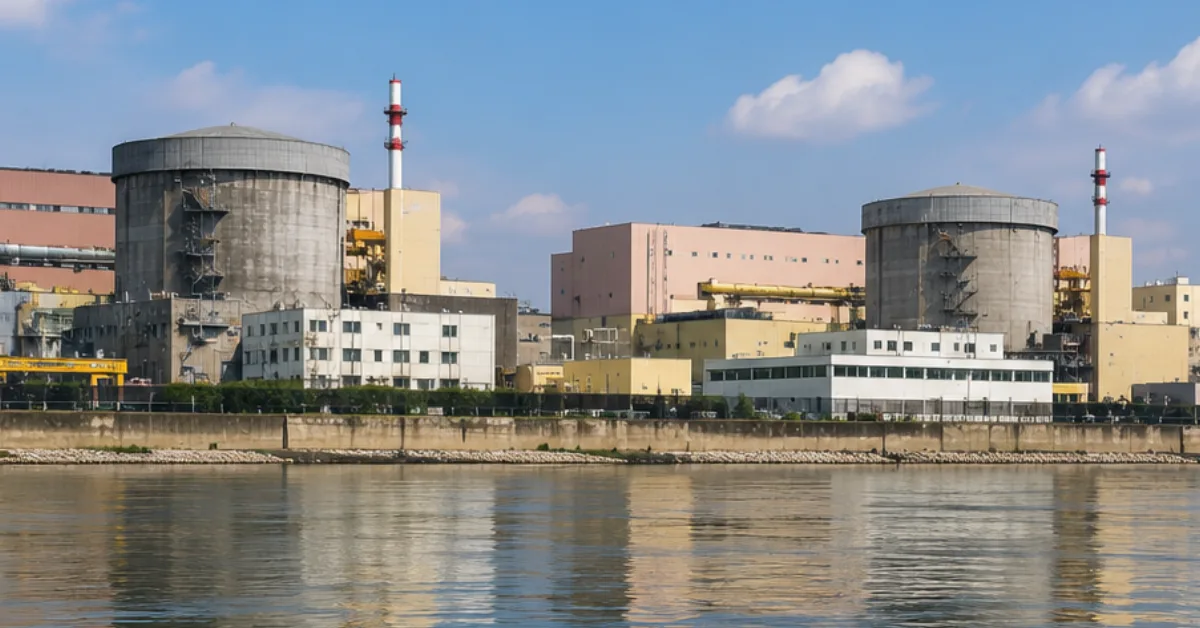
Romania is facing an energy alarm unlike anything the country has experienced in this form before. Because the Danube has fallen to an extremely low level, Unit 2 at the Cernavodă nuclear power plant is being shut down in a controlled procedure on Thursday, July 30, 2026. Unit 1 had already been disconnected from the grid on Tuesday. For the first time, both units are therefore offline at the same time because of insufficient water, removing roughly 1,400 megawatts of capacity from Romania’s electricity system in one blow.
The cause is not a technical defect inside the reactor, but the river flowing past the plant. Cernavodă relies on Danube water for cooling. The flow at Romania’s border dropped to around 1,650 cubic meters per second. A normal July level would be about 4,750 cubic meters. Authorities expect the flow could fall to roughly 1,500 cubic meters by August 4. For comparison, the historic low recorded in 1985 was around 1,400 cubic meters per second.
Each of the two reactors supplies about 706 megawatts. Together they normally account for approximately one fifth of Romania’s electricity production. Having both units leave the grid simultaneously because of low water is therefore far more than an unusual operational interruption. It is a stress test for the entire energy system, arriving in the middle of a European heatwave that is pushing demand higher through air conditioning and refrigeration.
Romania’s Energy Ministry had expected peak demand of around 7.3 gigawatts this week. Even before the second reactor was shut down, domestic generation had at times reached only about 4.3 gigawatts. The missing output must now be covered to a greater extent by other power stations, electricity imports and available reserves. Officials stress that homes and businesses should continue to receive a secure supply. No nationwide blackout has been announced, and no local power cuts have been reported either. Nevertheless, the system is under noticeably greater pressure, while higher wholesale electricity prices are also considered likely.
The strain does not stop at Romania’s border. Hungary’s Paks nuclear power plant has also had to shut down one of its four reactors because of the low Danube, after output from additional units had already been reduced. The drought is therefore affecting several major power plants along the same river at the same time. What appears to be a regional water problem is suddenly becoming a European energy issue.
The combination of heat, drought and declining electricity generation is particularly dangerous. While demand rises, power stations lose part of their output or must stop completely for safety reasons. Hydroelectric plants may also generate less, while imported electricity becomes more expensive when neighboring countries are struggling with the same conditions. A single outage can usually be balanced in an interconnected grid. Several shortages occurring at once, however, can rapidly erode the available reserve margin.
Romania is now in a race against the weather and the river level. The reactors may only be restarted once the required cooling conditions can again be met safely. Until then, the country will depend more heavily on imports and other generators. The coming days will show whether the grid can remain stable through the heatwave or whether the historic drought will force further emergency measures.
Source: Reuters, “Low Danube river levels force Romania to shut down both of its nuclear power reactors”, July 29, 2026; Associated Press, “Danube River reaches record low water levels during prolonged drought”, July 30, 2026; Nuclearelectrica, current reports on the controlled shutdown of the reactors at Cernavodă.
Latest updates
General
30.07.2026
Danube at record low: Romania takes both nuclear reactors offline
Historic water shortages force Romania to shut both Cernavodă reactors. Around 1,400 megawatts disappear from the grid during a heat wave.