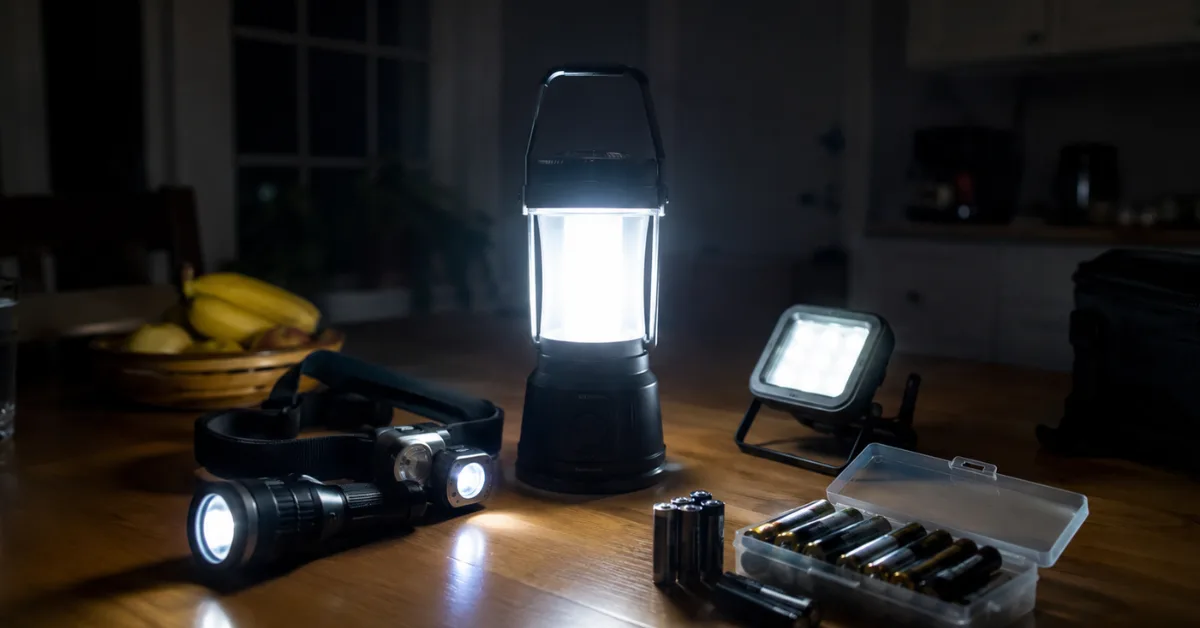
When a power outage suddenly leaves everything dark, many people first reach for their phone or for candles. Neither is suitable as the main solution: the phone is needed for communication, while open flames increase the risk of fire, especially in unfamiliar darkness. A safe lighting plan therefore uses several electric light sources, each with a defined job.
For basic room lighting, use a stable LED lantern with low and high brightness settings. It spreads light better than a flashlight and can be placed on a table or another raised, secure surface. One lantern, however, is not enough for an entire household. Every person should also have their own flashlight. A headlamp is particularly useful because it keeps both hands free when using stairs, caring for a child, checking the breaker panel or opening stored supplies.
Divide your lighting into three zones. Orientation lighting belongs near stairs, corridors, bathrooms and exits. Task lighting is switched on only where someone is cooking, measuring medicine or carrying out a repair. Personal lighting stays with the person using it. This avoids keeping the entire home brightly lit and makes batteries last much longer.
Choose LED lights with several brightness levels whenever possible. The lowest setting is often enough for walking around and talking. Point a flashlight towards a light-colored wall or ceiling instead of shining it directly into another person’s face. This creates softer room light and helps preserve night vision. Flashing and turbo modes are usually unnecessary indoors and use an excessive amount of energy.
Keep the correct spare batteries for every important light. The simplest approach is to use as few battery sizes as possible, mainly AA or AAA, for example. Store batteries in a cool, dry place away from metal objects. Remove leaking, damaged or swollen batteries and rechargeable cells from your supplies immediately. Rechargeable lights should be charged regularly but should not be left permanently unattended on improvised chargers. A power bank is useful backup power, but it does not replace a light that accepts replaceable batteries.
Candles, tea lights and oil, kerosene or gas lamps should not form part of normal blackout lighting. They can be knocked over, ignite curtains or paper, and be forgotten when people are tired. Open flames are especially dangerous in children’s rooms, bedrooms, narrow corridors, near pets or anywhere fuel is stored. Battery-operated LED candles provide orientation light without an open flame.
Place at least one flashlight directly beside every bed and another in a fixed, easy-to-reach location near the entrance. Nobody should have to walk through a dark home to find a light. Glow-in-the-dark markers on stair edges, door frames or the breaker panel can provide additional guidance without using electricity.
Test every light once a month. Check switches, charge level, contacts and spare batteries. Write the inspection date on a small card kept in the emergency box. Children and older household members should also practise which light belongs to them and how to select the low setting.
The aim during a blackout is not to illuminate every room as brightly as usual. What matters is having safe routes, free hands and enough reserves for several nights. One LED lantern for each occupied area, one personal flashlight or headlamp per person and an organised battery system provide more safety than a drawer full of untested lamps.
Sources: Ready.gov, “Power Outages”; American Red Cross, “Power Outage Safety”; London Fire Brigade, “Candles – Fire safety at home”.
Guides
General
16.07.2026
Safe lighting during a blackout: stay bright without a fire risk
LED lanterns, flashlights, and headlamps are safer than open flames. Plan lighting zones, batteries, and fixed storage points for several nights.