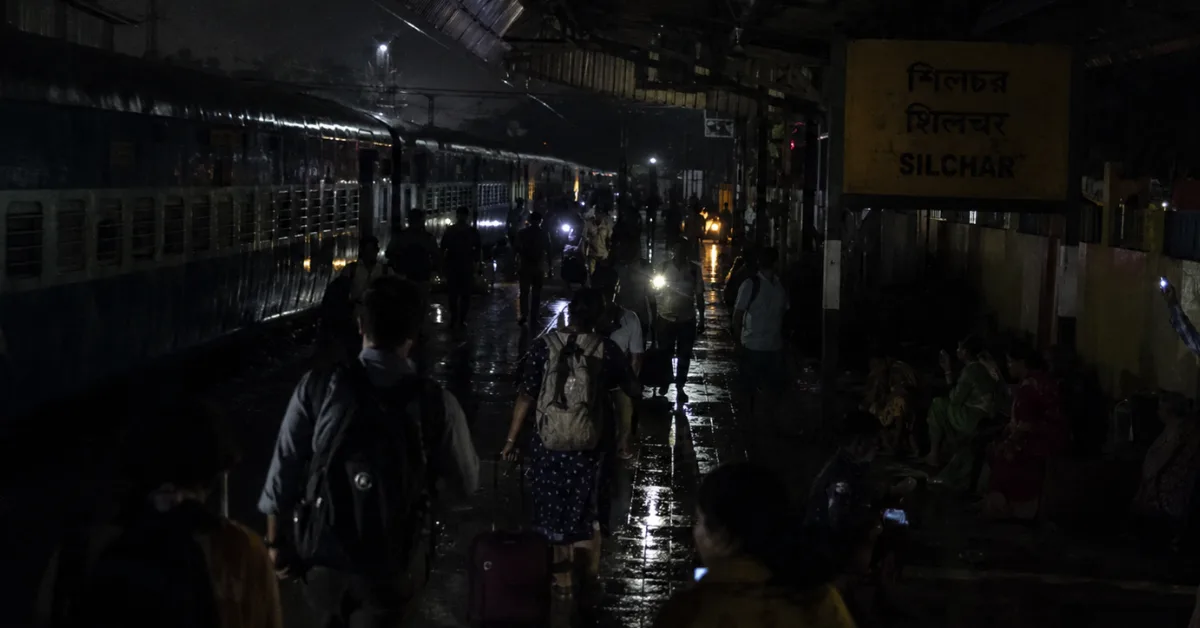
A violent storm effectively plunged Silchar railway station in the northeastern Indian state of Assam into darkness on Wednesday evening. The power supply failed for more than three and a half hours. Hundreds of travelers stood on poorly lit platforms while several essential technical systems went silent at the same time. What first appeared to be a local fault quickly turned into a chaotic evening for many passengers.
According to the Times of India, a power tower in the railway yard near the station power house collapsed. Shortly after nightfall, the lighting, telecommunications, computerized services, public announcement system and coach position displays stopped working. In an instant, the very systems intended to provide orientation and safety at a busy station were unavailable.
The situation was particularly difficult for older people, women and families traveling with children. Many passengers had to use the flashlights on their mobile phones to find their way around the platforms. Because the coach position displays were not working, people ran alongside the train with their luggage, trying to locate their reserved compartments. Automatic announcements about arrivals, departures and platform allocations also remained silent.
The Silchar–Charlapalli Express, train number 14646, was still able to depart on schedule at 7:10 p.m., but boarding became an ordeal for many passengers. Computerised ticketing and internal communication channels were affected. For railway staff, the outage meant that some procedures had to be coordinated manually.
No major safety incident was reported despite the darkness and technical failures, and train services continued. That is precisely what makes the incident so serious: a station may appear to remain operational while almost all digital assistance has failed in the background. Without lighting, displays and announcements, the risk of falls, passengers being directed incorrectly, missed trains and panic can rise within minutes.
Station superintendent Bikramjit Nath said a powerful evening storm had caused the tower to collapse. Teams were working to remove the damaged structure and restore the electricity supply. Engineers were initially unable to provide a reliable time for full repairs. The prolonged outage therefore raised fresh questions about the resilience of backup power at one of the Barak Valley’s busiest railway stations.
The incident also exposes an uncomfortable dependency. Modern stations do not rely on electricity only for lighting. Passenger information, ticketing, communication, surveillance and internal coordination all depend on it as well. When the normal supply fails, backup power must support more than a few lamps; it must keep a clearly defined group of critical systems running. If those systems are not prioritized, or if the reserve is insufficient, a station can quickly slip into dangerous blind operation even while trains are still moving. Regular load tests, functioning batteries and rehearsed manual procedures are therefore not minor technical matters but part of public safety.
For travelers, the case is a clear warning. A charged phone, a small torch, an offline copy of the ticket, the train number, coach and seat details, and an emergency number written on paper can be crucial in such a situation. Anyone relying only on displays, internet access and loudspeaker announcements can lose all orientation within seconds of a power outage.
The evening in Silchar shows how one fallen tower can throw an entire transport hub into disorder. The trains kept running, but for hours the station lost its digital nervous system. Those responsible now face an uncomfortable question: why was the available backup power unable to keep essential services operating reliably?
Source: Times of India, July 15, 2026, “Power outage cripples Silchar railway station”.
Latest updates
General
16.07.2026
Station in darkness: Storm cripples Silchar for hours
A fallen power tower left Silchar railway station in Assam without electricity for more than three and a half hours. Hundreds of travelers searched for their coaches by phone light.