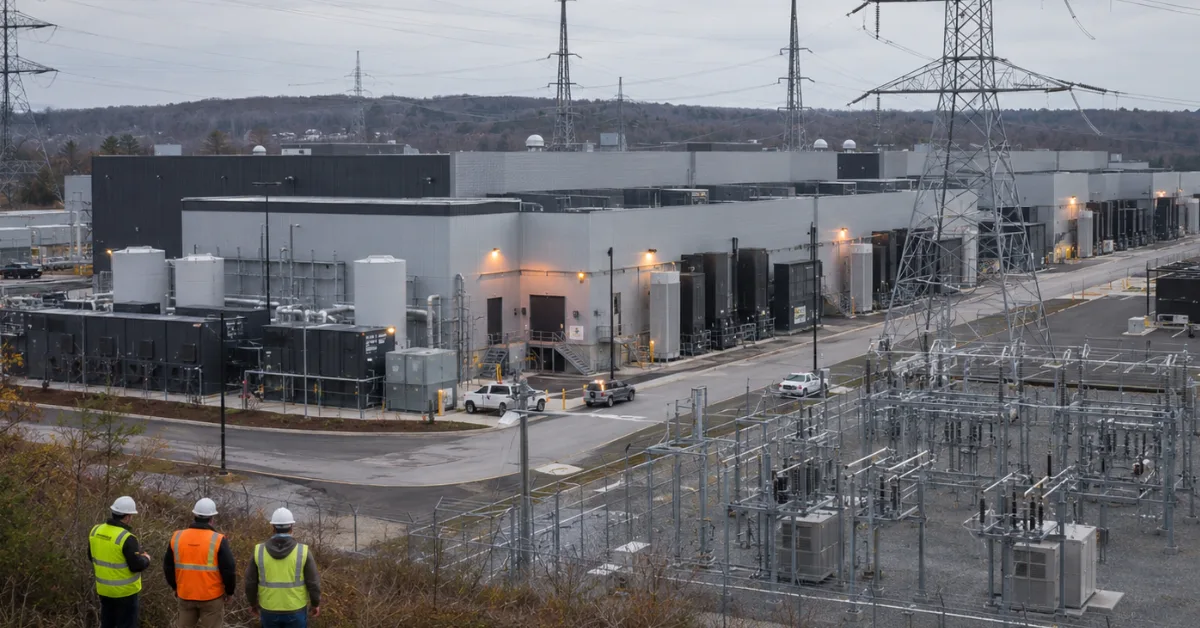
A technical incident at the heart of America's digital economy knocked the largest US power grid off balance for several minutes on Wednesday, 22 July 2026. The disturbance began in Northern Virginia, the region with the world's largest concentration of data centers. When a transmission line went out of service, numerous facilities automatically disconnected from the public grid and transferred to their own backup power.
What happened next sounds contradictory at first. The grid was not shaken by a sudden shortage of electricity, but by the abrupt disappearance of an enormous block of demand. Operating data from grid operator PJM showed that more than three gigawatts of load dropped off almost simultaneously. That was roughly three per cent of total electricity demand on the PJM system at the time. On a grid where generation and consumption must match as closely as possible every second, a jump of that size is anything but harmless.
The voltage disturbance was measurable far beyond Virginia. Ting Labs' sensor network recorded effects along the US East Coast and as far west as Chicago. Customers in Northern Virginia reported flickering lights and unusual noises from air-conditioning units and refrigerators. A widespread blackout did not occur, but experts said power quality took a significant hit.
Grid operators normally correct small disturbances in milliseconds. This time, according to Ting Labs chief executive Bob Marshall, it took about ten minutes for the system to become fully stable again. Dominion Energy said its operations team stabilized the situation within minutes and restored normal operating conditions. PJM stressed that the incident did not have a lasting impact on grid reliability.
Even so, the event is highly significant. PJM supplies about 67 million people across a territory stretching from Washington, D.C., to Chicago. Northern Virginia is also regarded as the world's biggest data-center hub. Its facilities support cloud services, artificial intelligence, business software, streaming platforms and countless digital services that have become part of daily life. When many of these huge consumers switch to backup power at the same time, grid demand changes within seconds.
The incident exposes a new side of power-grid risk. Attention usually focuses on insufficient generation, extreme heat, storms or failed power stations. Yet a sudden collapse in demand can also disrupt frequency and voltage. That is precisely why regulators and grid operators are already studying how data centers, cryptocurrency mines and other enormous consumers can be better integrated into stability planning.
For ordinary households, the event was mainly noticeable as brief flickering. It would nevertheless be a mistake to dismiss it as a meaningless technical hiccup. The grid held, but the incident showed how tightly digital infrastructure and electricity supply are now linked. A single line fault can simultaneously set data centers, emergency generators and a power system serving millions of customers into motion.
The central lesson is clear: a modern power grid can come under pressure not only when demand becomes too high. It must also react at lightning speed when several giant consumers suddenly disappear. This time the result was a ten-minute disturbance without a widespread outage. Next time, high demand, additional line faults or weaker reserves could combine to make the consequences far more serious and actually disconnect customers.
Source: Reuters, 22 July 2026, “Massive disconnect of power roils largest US electric grid”. Additional information: PJM Interconnection and Dominion Energy.
Latest updates
General
23.07.2026
Three gigawatts vanish: Data centers shake America's largest power grid
After a transmission-line fault, Northern Virginia data centers disconnected together. More than three gigawatts of demand vanished within seconds.