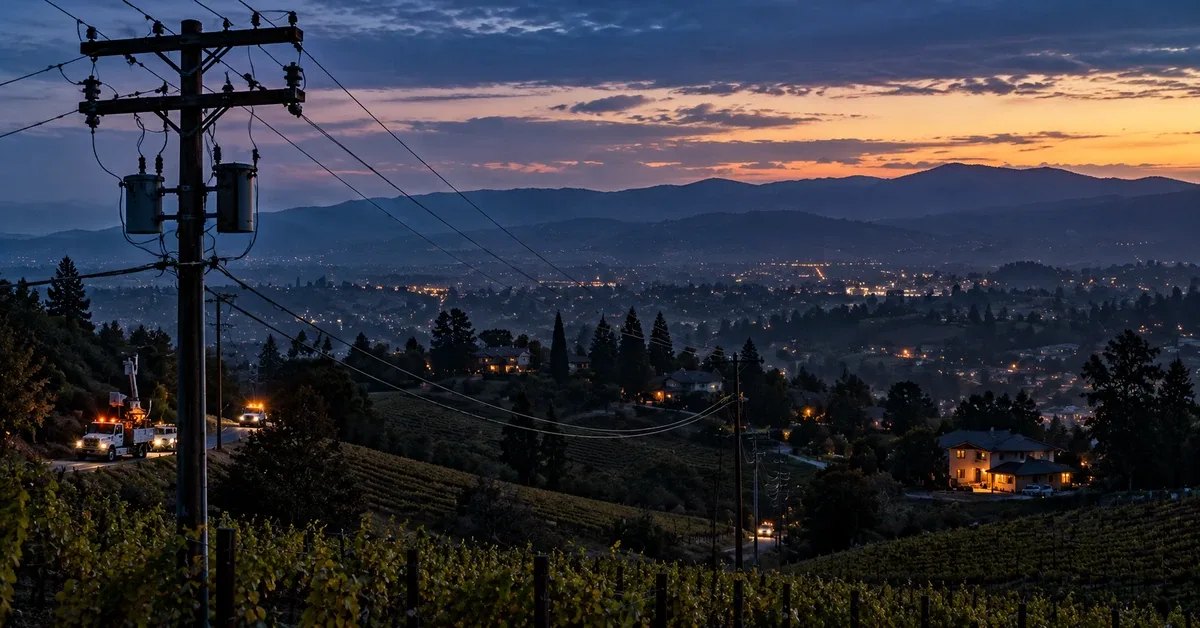
More than 5,000 electricity customers in California's Wine Country were affected by two significant unplanned outages on Friday, October 2, 2026. According to the San Francisco Chronicle and utility Pacific Gas and Electric, or PG&E, the interruptions mainly affected Napa County and the city of Santa Rosa in Sonoma County. The causes were still under investigation. This was not a large-scale blackout, but it is a current example of how several thousand homes and businesses can suddenly lose grid power at the same time.
The first major outage began at about 4:50 p.m. near Angwin in Napa County. Around 1,963 customers lost service. The affected area extended toward Deer Park and along Highways 29 and 128 toward Pope Valley. PG&E initially estimated that service in the Napa area could be restored by about 3 a.m. Saturday. For some households, that meant the possibility of spending many hours without grid electricity.
A second outage began shortly before 6 p.m. in Santa Rosa and affected about 3,421 customers. Restoration there was much faster. Roughly 1,000 customers had power back within around 30 minutes, and by about 6:40 p.m. nearly everyone affected had been reconnected. At the time of reporting, the causes of both interruptions remained under investigation.
The incidents are useful because they show two very different outage patterns. Electricity can return after a few minutes, or an interruption can continue deep into the night. At the beginning, a household usually cannot know which situation it faces. That uncertainty makes the first minutes important: refrigerator and freezer doors should stay closed, phones should not be used unnecessarily, and battery lighting should be easy to reach.
California has extensive systems for tracking and reporting outages. PG&E directs customers to its Outage Center for current information. At the same time, the utility reported no broader grid constraint for October 2. That distinction matters. Local equipment failures, damaged lines or other technical problems can interrupt thousands of connections without indicating a statewide electricity shortage.
For blackout preparedness, this is a practical lesson. A household does not need a national grid collapse before its emergency supplies become useful. A regional outage can stop lighting, internet access, card payments, electric garage doors, refrigeration, pumps and chargers. People working from home or relying on electrically powered equipment can feel the effects immediately.
The event also shows why the start time should be written down. Knowing when electricity failed helps a household judge the duration and make better decisions about refrigerated food, battery reserves and backup power. During a longer interruption, official utility updates should be checked without draining a phone by refreshing constantly.
The key point is that Napa County and Santa Rosa experienced local, unplanned outages, not a California-wide blackout. Yet these more ordinary events are realistic tests of preparedness. A home with lighting, communication, cooling procedures and a modest reserve of electricity can handle several hours without grid power much more calmly.
Sources: San Francisco Chronicle and PG&E. Updated: October 3, 2026.
Aktuális hírek
Általános
03.10.2026
Kalifornia: több mint 5000 fogyasztó maradt áram nélkül Napa és Santa Rosa térségében
Két nem tervezett áramszünet több mint 5000 fogyasztót érintett a kaliforniai borvidéken.