
Preserving recipe
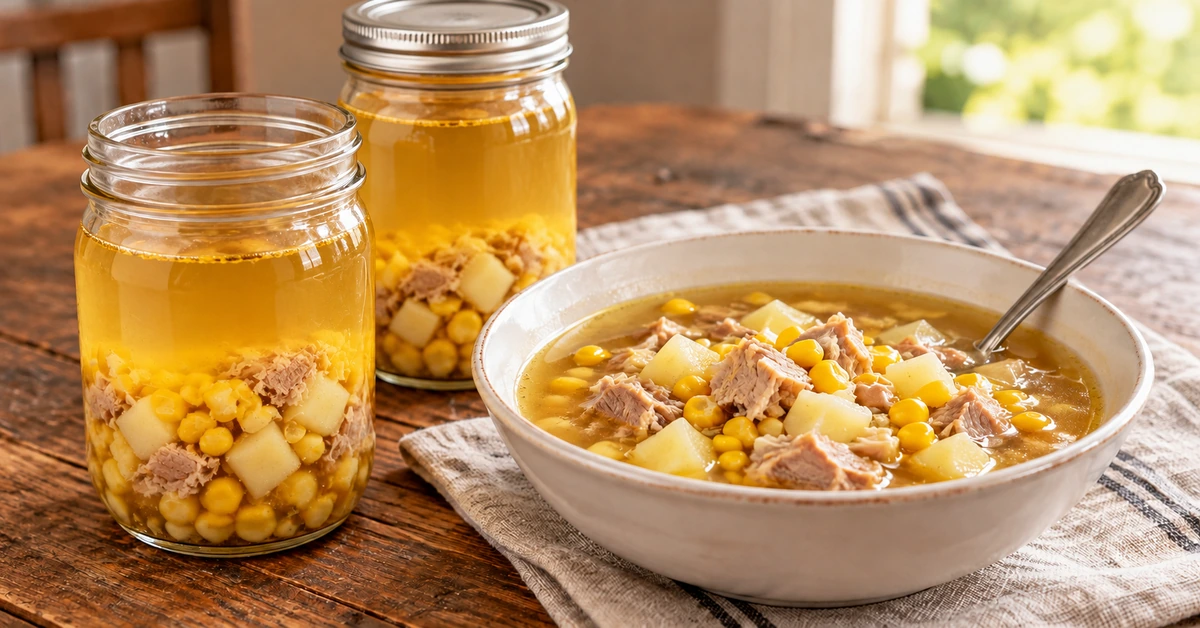
Pork, sweetcorn and potato stew in jars
Tender pork, sweetcorn and potatoes in clear broth: a ready meal without beans. Packed in pieces without thickening and preserved exclusively in a pressure canner.
30 min.
150 min.
6
6
Medium
Ingredients
500 g waxy potatoes, weighed peeled
300 g fresh sweetcorn kernels, weighed after blanching and cutting from the cob; buy fresh sweetcorn cobs
1800 ml drinking water for the meat and broth, with an extra 500 ml if needed; separate water for precooking vegetables and the canner
8 g salt, optional
Method
2. Cut pork into pieces about 20 mm across, cover with the 1800 ml water and cook until fully tender. Add water if needed. Cool briefly, remove meat and reserve the cooking liquid after removing its fat.
3. Wash and peel potatoes, cut into cubes about 13 mm across, precook in boiling water for 2 minutes and drain; discard that water. Husk sweetcorn cobs, remove silks, wash and blanch in boiling water for 3 minutes. Cut kernels at about three quarters of their depth; do not scrape the cob. Bring the weighed kernels to a boil with hot water at a volume ratio of 4 parts sweetcorn to 1 part water and simmer for 5 minutes.
4. Cover meat, potatoes and sweetcorn with defatted meat broth, add hot water if needed, optionally salt and boil for 5 minutes. Loosely distribute solids in hot jars: fill each jar no more than halfway with solids. Top up with boiling broth, leaving 25 mm headspace. Remove bubbles, adjust headspace, clean rims and close lids. Do not force all ingredients into a fixed number of jars.
5. Place jars on the rack in the canner prepared with hot water according to the manufacturer. Close it and leave the steam vent open initially. Once steam flows steadily, vent fully for 10 minutes, then pressurise. Gauge pressure for a dial-gauge canner: 11 psi up to 600 m elevation; 12 psi above 600 to 1200 m; 13 psi above 1200 to 1800 m; 14 psi above 1800 to 2400 m. Weighted gauge: 10 psi up to 300 m, 15 psi above 300 m. Do not use these instructions above 2400 m.
6. Process for 60 minutes only after the required pressure is reached, maintaining it throughout. If it falls below the required level, restore pressure and restart the full 60 minutes. Turn off the heat and allow the canner to depressurise naturally; do not release steam or cool with water. Only when fully depressurised, open the vent according to the manufacturer, wait 10 minutes, carefully open the lid away from your face and lift jars upright.
7. Cool jars undisturbed for 12–24 hours; do not retighten or invert. Check seals, remove screw bands and date. Refrigerate correctly processed, freshly cooled jars that did not seal immediately and use within 48 hours. Heat contents thoroughly in a saucepan before serving.
Storage
Store only correctly processed, sealed jars in a cool, dark, dry place, ideally at 10–21 °C. Refrigerate immediately after opening at no more than 4 °C and use clean utensils.
Shelf life
For best quality, use unopened jars within 12 months. Use opened jars promptly while refrigerated. Use correctly processed, freshly cooled jars that did not seal within 48 hours at no more t
Safety note
Preserve only in a suitable pressure canner. A water bath, oven, hot filling alone or ordinary pressure cooker is insufficient. Precook vegetables, discard potato cooking water, fill jars no more than halfway with solids and follow pressure and time. Do not purée or add dairy, flour, starch, rice or pasta. Do not substitute cured meat, bacon or cream-style corn. A sealed lid alone does not prove safe processing. Never taste incorrectly processed jars, jars that lose their seal later, or jars with bulging lids, mould, gas or an unusual smell; safely discard all contents. Heating does not reliably make incorrectly canned food safe.